Evolve on Sundays: PLCs Targeted, Blueprints Stolen, Cloud Credentials Exposed
AI-assisted tooling moved toward industrial controllers, Clop pursued engineering intelligence, exploited software exposed cloud credentials and root access, and DDoS attacks disrupted major communications platforms.
 PTC continued updating its Windchill and FlexPLM security advisory as investigators connected the platform to a broad data-theft campaign. Official image: PTC.
Security, software, and technical intelligence for the week ahead.
Coverage window: Sunday, August 16 through Saturday, August 22, 2026, with final editorial verification on Sunday morning, August 23.
The most consequential attacks this week converged on systems that already possess authority. Product-lifecycle platforms hold drawings and manufacturing records. Identity services decide who may enter. Source-code platforms preserve the history from which software is released. Machine-learning systems inherit cloud permissions. Administration servers can act across hundreds or thousands of machines.
Clop's reported campaign against PTC Windchill illustrates the strategic value of that access. The victims were not merely storing customer names. Windchill and FlexPLM can contain engineering drawings, production plans, supplier relationships and the institutional record of how a product is made. The FBI separately warned that actors were developing capability against U.S.-based Siemens controllers with AI-generated exploitation scripts. Microsoft corrected an initially alarming disclosure and now says a maximum-severity Entra ID flaw is not known to have been exploited. Rust removed malicious package releases after a maintainer account or computer was apparently compromised, and GitLab exploitation arrived almost immediately after disclosure.
The lesson is not that every control plane is equally exposed. It is that the value of a compromise is increasingly determined by inherited authority. A foothold inside a management layer may supply information, credentials and downstream reach that once required several separate stages of intrusion.
Editorial methodology: Evolving Cyber prioritizes primary advisories, government notices, regulatory records and original research. Confirmed exploitation is separated from vendor assessment, criminal claims and editorial analysis. Each newspaper page ends with direct links to its principal sources.
01Security Headlines
From the factory floor to the cloud control plane
 Clop's Windchill campaign supplied the enterprise data-theft lead as the week's wider activity reached industrial, development and cloud control systems. Source image: BleepingComputer.
The week's lead was the movement of attack activity toward systems with authority over physical processes, product designs, software delivery and cloud access.
The FBI warned that actors were developing capability against U.S.-based Siemens S7 controllers with AI-generated exploitation scripts. No new physical disruption was reported, but a separate Rockwell campaign had already caused pressure loss and flooding in American water systems.
Clop named 43 organizations in its Windchill campaign, while Philips confirmed an attempted compromise and other companies investigated claims. Windchill may contain blueprints, supplier relationships and change histories. Elsewhere, malicious Rust releases entered trusted dependency paths, GitLab exploit attempts followed disclosure, MLflow exposed cloud credentials, a macOS bypass delivered root access and Bluesky confirmed a DDoS outage.
Attacks and incidents in this edition
| Incident | Category | Evidence status | Page |
|---|---|---|---|
| Siemens S7 PLCs | Industrial targeting | FBI warning | 2 |
| Clop / PTC Windchill | Enterprise data theft | Partly confirmed | 2 |
| macOS CVE-2026-65400 | Root compromise | Active exploitation | 3 |
| Bluesky | DDoS | Confirmed | 3 |
| Threema | DDoS | Confirmed; prior-week context | 3 |
| Rust crates.io | Software supply chain | Confirmed | 4 |
| GitLab CVE-2026-19478 | Application exploitation | Attempts observed | 4 |
| MLflow CVE-2026-64849 | Cloud credential theft | Active exploitation | 5 |
| Zimbra CVE-2026-73570 | Server compromise | Active exploitation | 5 |
| TrueConf Server | Exploited vulnerability | CISA-confirmed | 5 |
| France tax systems | Government data breach | Confirmed | 6 |
| Dahua cameras | Camera compromise | Research-confirmed campaign | 6 |
| Apollo Global Management | Cloud data breach | Confirmed | 6 |
| CareCloud | Healthcare breach | Revised impact | 6 |
Root access through macOS Screen Sharing — Page 3
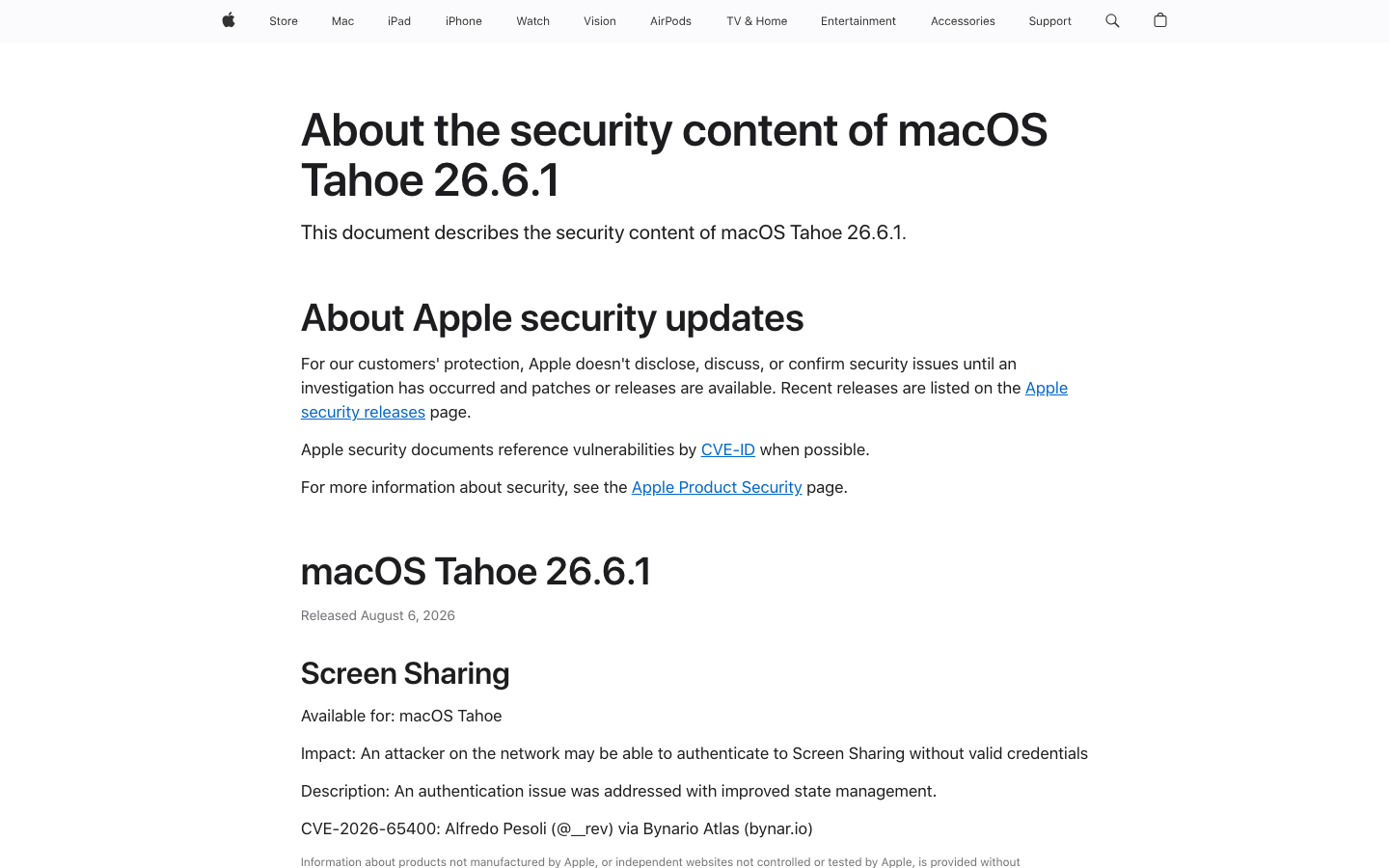
Attackers exploited an authentication bypass in internet-exposed Mac Screen Sharing services, obtained root access and installed Monero miners. Apple had already issued corrections, but the exploitation evidence changed the operational question from whether systems were vulnerable to whether older or exposed Macs had already been entered.
The vulnerable service listens on TCP port 5900. Apple corrected Tahoe, Sequoia and Sonoma, while investigators cautioned that root access supports activity beyond the mining payload observed in the reported cases.
MLflow servers exposed cloud credentials — Page 5

Active exploitation of an unauthenticated MLflow flaw allowed attackers to direct trusted servers toward cloud metadata services and seek temporary credentials. The consequence depended on the workload role attached to each deployment: a model-management server with broad storage or secrets access could turn one forged request into a wider cloud-control incident.
MLflow releases before 3.15.0 are affected. Upgrading closes the request path, but organizations with exposed deployments still need to identify the attached workload identity and review whether issued sessions reached storage, secrets or other cloud services.
France's taxpayer breach became a national crisis — Page 6

France confirmed that attackers extracted detailed tax records and that stolen files later appeared for sale. The case moved beyond a technical intrusion as officials investigated the scale, the extraction route and claims involving other public data. Tax records combine identity, income, property and household information that cannot simply be rotated after exposure.
A sample reviewed by Le Monde reportedly contained more than 600,000 entries. Officials said the attacker combined a stolen tax-employee credential with external access and shaped extraction to remain below ordinary detection thresholds.
02Security Investigations
Clop raided the engineering vault
Philips and GE were among the companies investigating Clop's claims after a large group of Windchill-related victims appeared on the gang's leak site. Image: BleepingComputer.
The Clop extortion group listed a batch of 43 organizations in what researchers and affected companies connected to exploitation of PTC Windchill and FlexPLM. Philips confirmed that an attacker attempted to compromise a particular enterprise server and said the activity was contained. GE said it was assessing a claim. Shell was also reported to be investigating an allegation that 89 gigabytes had been taken. Public confirmation remains uneven across the full list, so the gang's victim count is an allegation rather than a final incident census.
The campaign nevertheless has a well-established technical foundation. PTC has warned customers about critical, unauthenticated remote-code-execution risks affecting Windchill and FlexPLM and has repeatedly updated its advisory with indicators, web-shell patterns and urgent remediation instructions. On August 20, PTC added two further vulnerabilities involving deserialization of untrusted data: critical RCE CVE-2026-77645 and SSRF CVE-2026-77646. Those new entries do not by themselves prove which flaw produced every Clop intrusion; they show that the exposed product family remained under intensive investigation.
Why Windchill data is different
Windchill is a product-lifecycle-management system. In aerospace, automotive, industrial manufacturing, retail and medical technology, it may sit close to bills of material, drawings, supplier records, project plans, facility images, change histories and product configurations. Clop's claimed haul included backups, blueprints, diagrams and engineering documentation.
That changes the breach calculation. Personal information can support fraud, but engineering material can reveal how a product is assembled, where a facility depends on a particular component, which supplier relationships are fragile and what intellectual property took years to develop. Some files may have a useful life far longer than the vulnerable server through which they were reached.
PTC says its products serve more than 30,000 customers. That does not mean 30,000 victims, nor does it establish that every deployment was internet-accessible or vulnerable. It explains why a reusable route into the platform would attract a data-theft group skilled at turning one enterprise-product weakness into a campaign.
A custom web shell points to deliberate collection
Subsequent reporting described a purpose-built Windchill web shell used to enumerate repositories, recover stored credentials and collect data. A specialized tool matters because it suggests the operation was not opportunistic file grabbing after a generic compromise. The attacker had invested in understanding the application's data model and in converting platform access into repeatable extraction.
Forensics therefore cannot stop at confirming that a patch was installed. Investigators need to determine whether suspicious JSP files appeared, whether known or variant command headers reached the application, which repositories were enumerated, whether credentials stored by the platform were decrypted and where large responses or archives moved. PTC explicitly advises customers to hunt beyond its published file names because shells may use changing hexadecimal names.
The central unanswered question is scope. Clop publishes names to create pressure, and a listing is not independent proof of compromise or data volume. At the same time, partial confirmations, PTC's extensive indicators and the development of Windchill-specific tooling make the underlying campaign credible. The careful conclusion is not that every claim is true. It is that product-engineering systems became the target of an organized collection operation whose full victim and data count is still being established.
AI-assisted reconnaissance reached industrial controllers
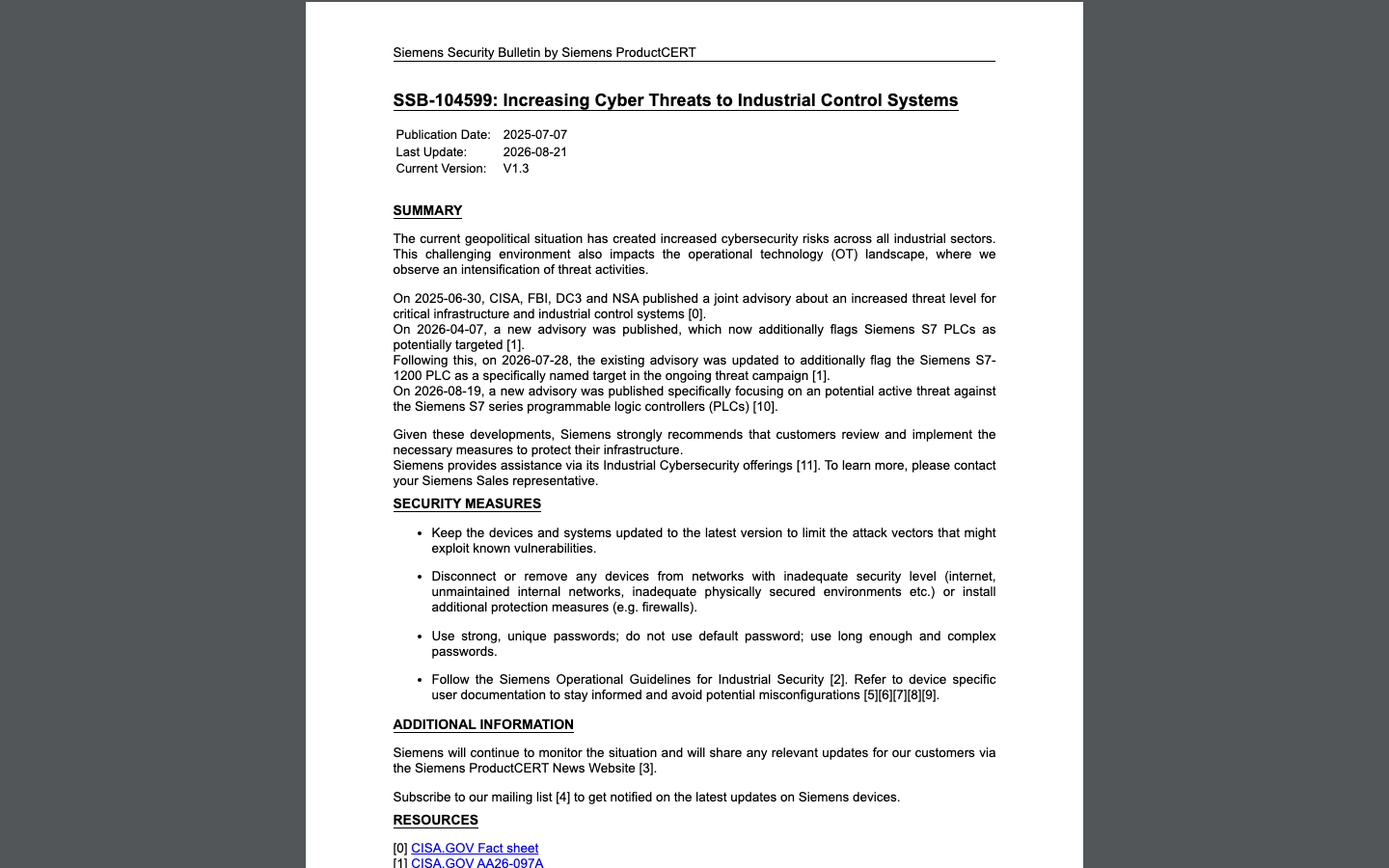 Siemens updated its industrial-control security bulletin after the FBI issued a new alert focused on S7-series PLCs. Official source: Siemens ProductCERT.
The FBI warned on August 19 that threat actors were conducting reconnaissance and capability development against U.S.-based Siemens S7 programmable logic controllers. The actors used AI-generated exploitation scripts disguised as legitimate monitoring tools. Siemens updated its own security bulletin on August 21 to reflect the active threat and specifically identified the S7-1200 among the equipment receiving attention.
This is not the same incident as the July attacks on Rockwell Automation MicroLogix controllers in U.S. water systems. The earlier campaign affected utilities in at least seven states and produced physical operating consequences including loss of pressure and flooding. The new Siemens alert describes preparation and attempted access against a different product family. Taken together, they show an adversary moving from exposed-controller discovery toward reusable automation across industrial brands.
The role of AI should be described precisely. The government did not say an autonomous model selected facilities or independently ran the operation. It said the actors used AI-generated exploitation scripts. That lowers the effort required to adapt probes and tooling, but the decisive weakness remains familiar: controllers reachable from the internet, exposed engineering interfaces and insufficient separation between monitoring access and physical process authority.
For industrial operators, the important distinction is whether a PLC only reports state or can change it. The same unauthorized configuration change can cause a blind spot in one facility and interrupt pressure, flow or safety logic in another. Asset inventories therefore need model, firmware, network path and process function—not merely an IP address and vendor name.
A warning about capability, not a claim of catastrophe
The Siemens alert is significant because it records adversary preparation near physical control, not because it proves that a new plant was damaged this week. That distinction should make the story more useful, not less urgent. Reconnaissance identifies reachable equipment, versions and exposed services. A script that can reproduce those checks across many addresses shortens the route from discovery to a list of plausible targets. Yet impact still depends on configuration, network placement, process design and whether the actor can move from observation to an authorized engineering function.
Industrial reporting often collapses those stages into the word “access.” Reading a status register is different from changing a set point; changing a set point is different from sustaining unsafe conditions against interlocks and operator intervention. The July water-system cases supplied evidence of real operating effects. The August Siemens warning supplies evidence of capability development. Together they justify attention without pretending the evidence says more than it does.
The reporting also shows why internet scans are an imperfect inventory. A controller visible at an address may be a laboratory device, a decoy, a gateway presenting a product signature or a production asset with consequential authority. Conversely, cellular modems, vendor maintenance paths and temporary engineering access can place real equipment outside the organization's ordinary network map. The defensible picture combines external observation with asset ownership and process knowledge.
Engineering data remains valuable after containment
Clop's campaign creates a different kind of persistence. A compromised password can be changed and a vulnerable server rebuilt. Drawings, manufacturing tolerances, supplier names and facility documentation cannot be rotated in the same way. Their value may lie in future extortion, competitive intelligence, fraud against a supplier or preparation for a more targeted intrusion months later.
That does not mean every stolen file creates the same risk. Investigators need to identify the product generation, sensitivity, contractual restrictions and operational context of the material rather than label an entire repository “intellectual property.” A current design package and an obsolete marketing render have different consequences. The work is slower than counting files, but it is the difference between a breach notification and an assessment of what the attacker actually learned.
The victim list is the beginning of the inquiry
Clop's publication strategy creates a public roster before every organization has completed forensic work. A company name may correspond to attempted access, a contained intrusion, copied files or a claim the victim disputes. Philips confirmed an attempted compromise; other organizations were still assessing the gang's statements. The page therefore treats 43 as the size of Clop's published list, not as a final count of independently verified data thefts.
The distinction also affects supplier notification. Windchill repositories can contain information received from customers and vendors, so the organization operating the server may not be the only party represented in the files. Document ownership, contractual controls and export restrictions can produce a second notification map that is larger than the server inventory.
For the Siemens activity, the comparable unresolved question is reach. Reusable reconnaissance can identify many exposed devices, but the number of scanned addresses does not establish how many controllers accepted commands or governed consequential processes. Evidence of configuration change, engineering-session activity and altered process state remains the line between capability development and demonstrated operational impact.
Sources for this page
- PTC — Windchill and FlexPLM active security advisory
- BleepingComputer — Philips and GE investigate Clop claims
- FBI — Defending Against an Active Threat to Siemens S7 Series PLCs
- Siemens ProductCERT — Increasing Cyber Threats to Industrial Control Systems
- FBI and EPA — Malicious actors targeting water-sector PLCs
03Security Desk
Microsoft corrected the record on a maximum-severity Entra ID flaw
 Microsoft corrected the Entra ID vulnerability in its cloud service and said customers did not need to deploy an update. Image: SecurityWeek.
Microsoft disclosed CVE-2026-69836, a critical Entra ID vulnerability that could permit unauthenticated remote code execution with low attack complexity. Its initial advisory marked the flaw as exploited. Microsoft later said that designation was a mistake and changed the status to “not known to be exploited.” Because Entra ID is a cloud service, Microsoft applied the correction server-side and customers do not deploy a patch.
The correction materially changes the story. There is no confirmed attacker, affected organization or in-the-wild campaign attached to this CVE. What remains established is narrower but serious: an unauthenticated code-execution weakness existed in a central cloud identity service, carried a CVSS score of 10.0 and was corrected by Microsoft. The incident is also a warning about vulnerability metadata: an erroneous exploitation flag propagated rapidly through news reports and advisories before the record was fixed.
Entra ID sits in the decision path for Microsoft 365, Azure and thousands of connected applications. Code execution in the service is not automatically equivalent to control of every tenant, and severity must not be used as a substitute for evidence of compromise. The appropriate current description is a provider-remediated, maximum-severity vulnerability that Microsoft says is not known to have been exploited.
Attackers used macOS Screen Sharing to obtain root access
Apple corrected the authentication weakness in macOS Tahoe 26.6.1 and corresponding updates for earlier supported releases. Official security information: Apple.
The Dutch National Cyber Security Centre observed exploitation of CVE-2026-65400 against Macs exposing Screen Sharing on TCP port 5900. The authentication bypass allowed an attacker on the network to connect without valid credentials. Investigators reported compromised systems on which attackers obtained root-level access and installed Monero cryptocurrency miners.
Apple released corrections on August 6 for Tahoe 26.6.1, Sequoia 15.7.9 and Sonoma 14.8.9. The exploitation reporting became a wider operational warning this week. The distinction matters: the patch was not new, but evidence that exposed systems were being compromised gave administrators a different reason to accelerate deployment and check for prior access.
Screen Sharing is often enabled for support and then forgotten. Its exposure should be reviewed at both the host and network boundary because a corrected laptop can still coexist with older Macs, unmanaged systems or firewall rules that make remote administration globally reachable. Mining was the observed payload in the reported cases; root access could support broader activity, so the investigation should not be limited to miner removal.
Bluesky confirmed a DDoS attack; Threema described a separate campaign
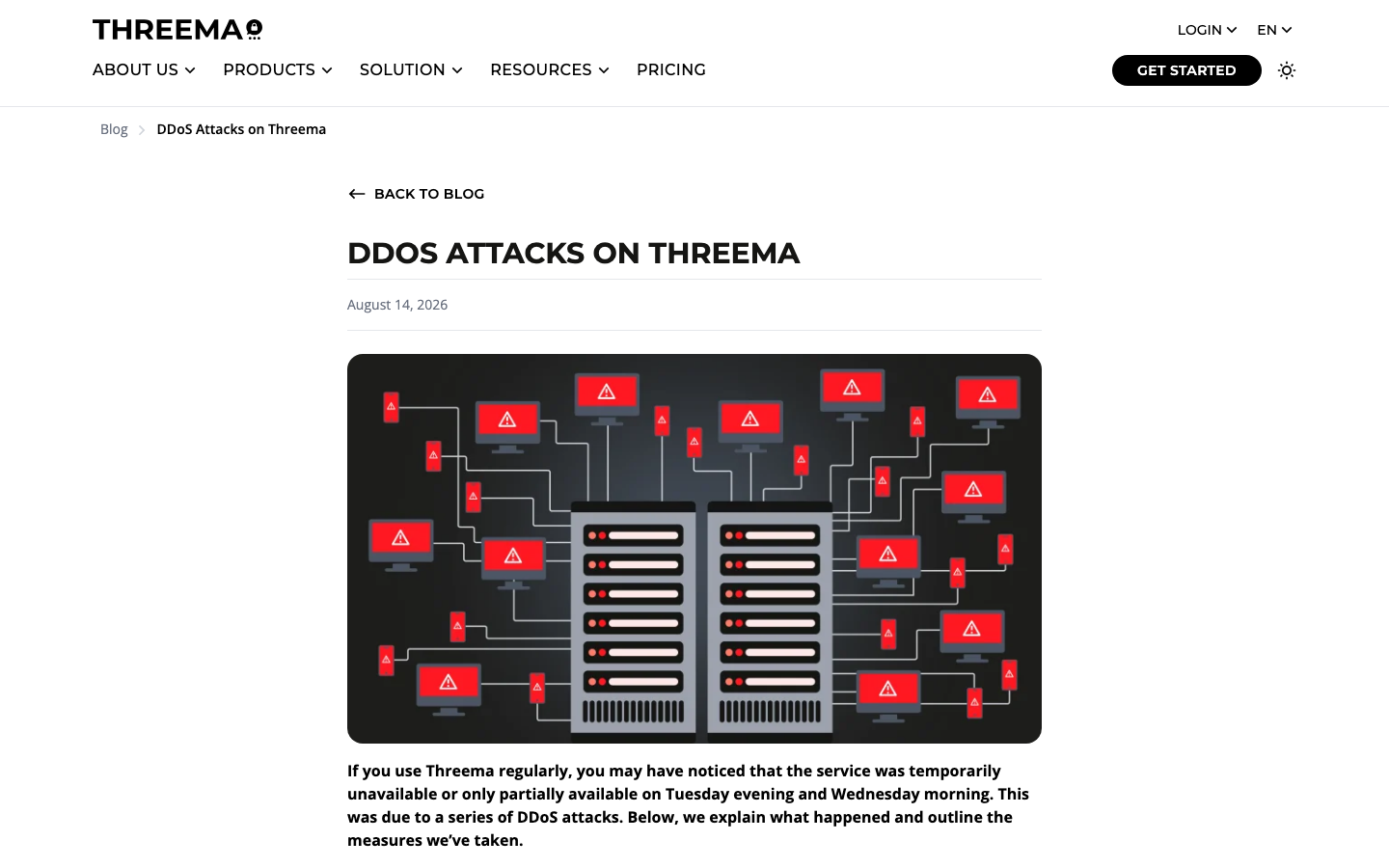 Bluesky and Threema described separate denial-of-service incidents affecting their hosted services. Source images: Bluesky and Threema.
Bluesky said the outage that began August 16 was caused by a distributed denial-of-service attack. Disruption extended for roughly a day while the service restored availability and strengthened defenses. A group calling itself Iraq-313 Team claimed responsibility, and some researchers described the group as Iran-linked; Bluesky did not make that attribution. The attack is confirmed. The identity and sponsorship of the attacker are not.
Threema's August 14 postmortem concerned a different attack just before this edition's coverage window. The encrypted-messaging provider said large-scale DDoS activity against Threema and its colocation partner Nine changed sources, traffic patterns and techniques as defenders reacted. Its hosted service was unavailable for four hours on August 11 and intermittently disrupted the following morning. Threema OnPrem installations were unaffected because they run on customer infrastructure.
The two incidents are useful together because neither was reported as a confidentiality breach. DDoS targets availability, and successful disruption does not by itself mean the attacker entered systems or obtained user data. The operational consequence can still be substantial when communication, identity or coordination depends on a hosted service. Cloudflare's broader observation of hundreds of attacks above one terabit per second provides scale context, not proof that either incident used that volume.
The scale changed; the attribution problem did not
Cloudflare reported that it mitigated 805 network-layer attacks above one terabit per second during the second quarter, more than six times the first-quarter figure. Across the first half of 2026, its total was 935. Those measurements come from one provider's network and should not be treated as a census of the entire internet, but they establish that volumes once described as exceptional are recurring operational events.
The median attack in the same dataset remained much smaller and shorter: 96.62 percent of network-layer events stayed below 500 megabits per second, and 90.6 percent ended within ten minutes. That distribution matters. A service can experience a damaging outage without appearing in a record-setting chart, while a very large flood may be absorbed automatically by infrastructure built for it.
Attribution is a separate evidentiary problem. Attack traffic can arrive through compromised devices, reflection services and rented infrastructure that say little about who ordered it. A public claim can demonstrate a group's desire for attention without proving access to the botnet that caused the outage. Bluesky's confirmation establishes the attack type. It does not validate every later claim of responsibility.
Availability depends on more than filtering capacity
DDoS resilience includes the path by which a service communicates during disruption. Threema acknowledged that its status page initially failed to update for a technical reason unrelated to the attack, then said it would add incident history and an RSS feed. That detail is operationally important: customers need a status channel that does not share the same dependencies as the unavailable service.
Upstream filtering can remove malicious traffic before it consumes the target's own links, but recovery also depends on DNS, load balancers, session state, authentication, third-party APIs and retry behavior. A platform may restore its front page while message delivery, federation or account access remains degraded. Incident reporting should therefore describe which user functions failed, not merely whether the domain responded.
Identity flaws and availability attacks require different evidence
The Entra ID correction and the DDoS incidents appeared in the same security week but should not be discussed with the same evidentiary shorthand. A maximum CVSS score describes the technical severity of a vulnerability under defined assumptions. It does not establish that an attacker used it. An outage and a provider's traffic analysis can establish denial of service, but a group posting a claim afterward does not establish who controlled the traffic.
For senior readers, the practical value lies in keeping four questions separate: what weakness or event was observed, who confirmed it, what effect was measured, and what attribution—if any—survives independent scrutiny. Collapsing them produces dramatic copy and poor incident intelligence. Preserving them lets an organization act on exposure immediately while leaving campaign and actor conclusions open until evidence arrives.
The week also demonstrated the importance of correction as part of the security record. Microsoft's initial exploitation label travelled quickly because it combined a central identity service, unauthenticated code execution and the highest severity score. The later correction should travel just as far. Updating a conclusion is not a retreat from urgency; it is the mechanism by which vulnerability reporting remains trustworthy.
Recovery measurements differ by service
Recovery is measured differently in each case. Screen Sharing can be tested host by host: corrected version, exposure removed, prior sessions reviewed and persistence excluded. DDoS recovery must cover the complete service path because a functioning home page does not prove that messaging or authentication recovered. For Entra ID, Microsoft corrected the cloud component while customers depended on the provider's record rather than deploying a binary.
Sources for this page
- Microsoft Security Response Center — CVE-2026-69836
- NVD — CVE-2026-69836
- SecurityWeek — Microsoft rolls out 22 fresh security patches
- Apple — Security content of macOS Tahoe 26.6.1
- BleepingComputer — macOS Screen Sharing flaw exploited
- TechCrunch — Bluesky says its outage was caused by DDoS
- Threema — DDoS attacks on Threema
- Cloudflare — DDoS Threat Report, first half of 2026
04Software & Security Desk
A trusted Rust package became the delivery mechanism
 The Rust Security Response Working Group removed the malicious releases and locked the affected account. Official image: Rust Project.
At 07:15 UTC on August 20, Rust's Security Response Working Group received a report that a crate called proc-macro1 was malicious. Its build script downloaded and ran a remote payload. The investigation then found that a popular, legitimate package—arrayref—had been republished with a dependency on the malicious crate. Compromised releases of internment and append-only-vec followed.
The exposure windows were short: arrayref 0.3.10 remained available for 86 minutes, internment 0.8.7 for 90 minutes and append-only-vec 0.1.9 for 107 minutes. Rust removed the releases, restored clean versions where necessary and locked the affected publishing account.
Short availability does not make the event trivial. Package managers are designed to distribute trusted code quickly. Automated builds, dependency refreshes and clean CI environments may fetch a release soon after publication. The malicious action occurred during the build, where developer and CI machines commonly hold repository tokens, signing material, cloud credentials or access to internal package systems.
Rust's investigation says the evidence is consistent with the maintainer's computer or credentials being compromised, not with the author intentionally publishing malware. That distinction matters both ethically and technically. The trust decision attached to the maintainer account remained valid in the registry while control of the mechanism behind it had changed.
Some security reporting has linked the operation to North Korean actors. The Rust project's public incident report does not make that attribution. This edition therefore treats it as a researcher or vendor assessment, not an established conclusion.
What teams can establish
The useful evidence is version-specific. Organizations can search lockfiles, build logs, registry caches and CI records for the affected package versions and for execution during the publication window. Simply inspecting the currently available package is insufficient because the malicious versions were removed. Build systems that preserve dependency manifests and immutable logs will be able to answer the question; systems that always reconstruct current state may not.
The incident also exposes a limitation of download counts. Arrayref had accumulated roughly 152 million downloads before the compromise, a measure of ecosystem reach rather than the number of malicious installations. The relevant numerator is how many builds resolved the affected version during its brief lifetime. That figure is not yet public.
A short publication window can create a long evidence tail
Package resolution is distributed across developer machines, hosted runners, internal mirrors, container builds and artifact caches. Each may have observed a different registry state during the same 86-minute period. An organization that rebuilt after the malicious version was removed may now see only the restored release even though an earlier job executed the unwanted build script.
This is why immutable dependency evidence matters more than a current package query. Lockfiles identify the version selected, but build logs establish when it was fetched and whether scripts ran. Registry-proxy records can show which internal clients requested it. Endpoint and network telemetry may identify the remote payload or subsequent connections. Container and artifact metadata can reveal whether the result moved beyond CI into a distributable image.
The account-locking response protected future publication, but downstream consumers still own the question of historical execution. A package ecosystem can remove a malicious release centrally; it cannot reach backward into every runner that already processed it.
Attackers moved against GitLab before many teams had finished reading the advisory
 The GitLab vulnerability reached project integrity rather than merely service availability. Image: SecurityWeek.
GitLab released corrections for CVE-2026-19478 on August 17. By August 20, WatchTowr honeypots had observed exploitation attempts. The CVSS 9.4 flaw allowed unauthenticated code injection through the GraphQL interface under particular conditions and affected Community and Enterprise editions.
Researchers said an attacker could modify or remove public projects and user data. More strategically, the weakness could affect the record on which software teams base trust: merge information, project state and the apparent history around a release. A repository does not need to disappear for an organization to suffer. If review evidence or project metadata can be forged, a later artifact may appear to have passed a process it never completed.
GitLab fixed the flaw in versions 19.2.4, 19.1.6, 19.0.8 and 18.11.11. The speed of observed exploitation is now familiar but still operationally important. Public disclosure collapses the interval between a vendor's correction and an attacker's reproducible request. Internet-exposed development systems that cannot move on that clock require compensating controls capable of restricting the affected interface while the update is tested.
The shared pattern
Rust and GitLab failed at different layers. In Rust, a trusted publisher path delivered an unwanted dependency. In GitLab, an application flaw threatened the state of the platform that records development work. Both demonstrate that software integrity depends on more than source review: identity, registry behavior, build history, project metadata and release evidence form one chain.
Repository availability and repository truth are different assets
A missing project produces an obvious operational event. Altered metadata is quieter. If an attacker can change a public project's state, remove evidence or manipulate the context around a merge, the repository may remain online while the basis for trusting its releases has weakened.
That makes independent release evidence important. Signed tags, externally retained build attestations, package-registry records and deployed artifact hashes can help reconstruct what was approved when the primary collaboration platform is itself in question. None is a universal answer: a signed tag proves who controlled a signing key, while an attestation is only as trustworthy as the builder and policy that produced it. Their value comes from creating evidence outside the single application under investigation.
The incident boundary also extends into automation. GitLab commonly holds runners, deploy tokens, webhooks, protected variables and integration credentials. An investigation into project-state manipulation should therefore ask whether the same application access could reach execution or deployment paths, even when the publicly described vulnerability emphasized project data.
Evidence that survives outside the platform
The two incidents can be tested through records created at different points in the delivery chain. No single record proves the entire release was trustworthy, but disagreement between them can expose where control changed.
| Evidence | What it can establish | What it cannot establish alone |
|---|---|---|
| Dependency lockfile | The version selected for a particular source revision | Whether its build script actually executed in every environment |
| Registry and proxy log | When and where a package archive was requested | What credentials were accessible to the process after installation |
| Signed tag or commit | Control of a signing identity over a named source state | That the packaged archive contained only that source state |
| Build attestation | Which workflow and builder produced an artifact | That the workflow, identity and builder were uncompromised |
| Deployed artifact hash | The exact binary or image present in an environment | Whether the artifact's provenance and review claims were authentic |
Sources for this page
05Vulnerability Desk
Attackers used MLflow to request cloud credentials
The MLflow flaw turned a model-management function into a route toward the cloud metadata service. Image: SecurityWeek.
Attackers exploited CVE-2026-64849, an unauthenticated server-side request forgery vulnerability in MLflow's model-registry webhook API, to reach cloud metadata services and obtain credentials. Reports placed exploitation within hours of the CVE assignment. CISA added the flaw to its Known Exploited Vulnerabilities catalogue, and MLflow versions before 3.15.0 are affected.
The weakness sits at the intersection of application behavior and cloud identity. A webhook legitimately asks a server to contact another address. If the destination is insufficiently controlled, an attacker may direct that trusted server toward a link-local metadata endpoint that is unreachable from the public internet but reachable from the workload. The response can contain temporary identity material associated with the machine or service.
The permissions attached to that identity determine the blast radius. A narrowly scoped role might reveal little. A training or registry platform with broad object-storage, secrets, deployment or experiment access can turn one server-side request into a control-plane incident.
MLflow's reported 60 million monthly downloads describe popularity, not the number of exposed instances. The confirmed operational facts are active exploitation, credential-focused behavior and a fixed release. Teams also need to rotate or invalidate potentially retrieved credentials where the platform was reachable and vulnerable; upgrading stops the request path but does not revoke what may already have been issued.
Scoping begins with the identity the metadata service returned
The first question after a potentially successful request is not only whether the MLflow server was patched. Investigators need the workload identity attached to that instance, the sessions issued during the exposure window and the APIs those sessions called. Cloud audit logs can then distinguish a retrieved credential from one used to enumerate storage, read secrets or alter another service.
Temporary credentials reduce lifetime but do not erase activity completed before expiry. The attached role's policy provides the theoretical ceiling; API history provides the observed path. Where logs are incomplete, the unresolved permissions should remain part of the incident scope rather than being treated as proof that no downstream access occurred.
Zimbra command execution moved into active exploitation
 CERT Polska observed attacks against the Zimbra flaw and published indicators for defenders. Image: SecurityWeek.
CERT Polska observed exploitation of CVE-2026-73570, an unauthenticated operating-system command-execution vulnerability fixed in Zimbra Collaboration 10.1.20. The exposure is conditional: the optional zimbra-snmp package must be installed and SNMP notifications configured. That condition should narrow triage rather than produce complacency.
Email and collaboration servers remain high-value targets because they combine external reachability, identity, messages, attachments and organizational context. Execution as the Zimbra service account is not necessarily root access, but it can provide the starting position for collecting communications, stealing credentials or moving toward other services.
Neither the threat actor nor its purpose was publicly established at the end of the coverage window. The responsible description is an active exploitation campaign of unknown attribution, not a confirmed espionage or ransomware operation.
The conditional exposure creates a useful triage sequence. Administrators can first establish whether zimbra-snmp is installed and notifications are configured, then preserve relevant service, web and process evidence before upgrading. A system outside those conditions does not share this specific path; it may still require the fixed release for the other security corrections carried with it.
Citrix published a critical NetScaler authentication bypass
Citrix corrected CVE-2026-19490, an authentication bypass affecting NetScaler ADC and NetScaler Gateway when configured as Gateway or AAA virtual servers. The CVSS v4 score is 9.3. There is no workaround, so the corrective path is an upgrade to a fixed build.
Norway's National Cyber Security Centre said exploitation was expected but, as of its August 20 notice, not known to be active. That status matters. The vulnerability belongs in the urgent queue because NetScaler appliances commonly sit on the external identity boundary, but “likely to be targeted” is not the same statement as “observed in attacks.”
The appliance's position makes post-update review necessary even without a confirmed public campaign. Gateway and AAA configurations terminate user sessions and mediate access to internal applications. Historical authentication anomalies, configuration changes and newly created accounts can provide evidence that a vulnerable edge was used before the organization reached the corrected build.
TrueConf entered CISA's exploited-vulnerability catalogue
CISA ordered federal agencies to address actively exploited TrueConf Server weaknesses, including CVE-2026-72529, a critical missing-authentication issue that can enable remote script execution. Collaboration infrastructure is again the common denominator: software designed to connect remote users also offers an externally reachable application surface and valuable identity context.
Operational priority table
| Priority | Exposure | What is established |
|---|---|---|
| Emergency | Internet-reachable MLflow before 3.15.0 | Active exploitation for cloud credential theft; upgrade and investigate identity use. |
| Emergency | Affected GitLab versions with reachable GraphQL | Exploitation observed soon after disclosure; preserve project and audit history. |
| Emergency | Zimbra 10.1 with SNMP package and notifications enabled | Active exploitation confirmed by CERT Polska; update and hunt published indicators. |
| Urgent | NetScaler configured as Gateway or AAA | Critical authentication bypass; patch required, but exploitation not confirmed in the cited notice. |
| Urgent | Internet-reachable Windchill or FlexPLM | Campaign evidence and extensive IOCs; patching alone does not establish absence of prior access. |
Sources for this page
- SecurityWeek — MLflow exploited for cloud credential theft
- CISA — Known Exploited Vulnerabilities catalogue
- SecurityWeek — Zimbra servers targeted in active exploitation
- Norway NSM — Critical Citrix NetScaler vulnerability
- NHS Digital — Citrix NetScaler security alert
- BleepingComputer — CISA orders agencies to patch TrueConf Server
06Breaches, Intelligence & Analysis
France's tax breach became a national political and security crisis
France's public-finance administration continued investigating unauthorized access and data extraction. Official identity: impots.gouv.fr.
The French government convened an interministerial crisis unit on August 17 as the consequences of the tax-system intrusion reported in last week's edition widened. Officials described an attacker who combined stolen credentials belonging to a tax official with an external access path, manually tested the environment and then automated extraction at a rate intended to remain below detection thresholds.
That sequence gives the incident greater analytical value than a raw record count. The access was not a single explosive export that obviously crossed a threshold. It was activity shaped around the institution's monitoring assumptions. Closing the route in June did not immediately establish what had been removed; the theft became public after information appeared for sale.
The government apologized and accelerated a wider security review. Reports cited 678,000 affected individuals and businesses, although public counts have varied as investigators and journalists describe different populations. The most defensible formulation is that hundreds of thousands were affected and that the final scope remains subject to reconciliation.
Attackers also claimed to hold Education Ministry information relating to millions of students and teachers. Le Monde reported that a reviewed sample appeared plausible. The ministry claim has not been fully authenticated, and this edition does not present the advertised row count as confirmed. The distinction belongs in the headline because criminal sellers benefit when partial validation is mistaken for proof of an entire dataset.
Fourteen thousand cameras were compromised in 35 days
 Researchers documented a campaign affecting more than 14,500 Dahua cameras, principally in Ukraine and Russia. Image: BleepingComputer.
Researchers at Hunt.io reported that an operation compromised more than 14,500 Dahua cameras between June 17 and July 22. The campaign combined known vulnerabilities, password attacks and recovery codes derived from device serial numbers. Most observed systems were in Ukraine and Russia.
The researchers recovered 407 megabytes across 2,616 files from infrastructure the operators had left accessible. That material helped reconstruct targeting and tooling, but it did not establish who directed the campaign or its ultimate objective.
Geography makes speculation tempting. Cameras can reveal movement, facilities and routine; in an active conflict region, access may carry intelligence or operational value. The evidence reported publicly does not justify describing the campaign as military tasking by a particular state. Its confirmed significance lies in scale and in the abuse of a recovery mechanism that converted a device identifier into a path around ordinary authentication.
The incident also complicates asset ownership. Cameras are often installed by facilities, safety or physical-security teams, while network and credential policy sit elsewhere. An internet inventory may find the address without identifying the person who can update the firmware, rotate credentials or replace a model whose recovery design is unsafe.
Apollo disclosed stolen identity data from cloud platforms
 Apollo disclosed unauthorized access to cloud platforms and theft of personal information. Official identity: Apollo Global Management.
Apollo Global Management disclosed unauthorized access to certain cloud platforms between July 6 and July 10. The stolen information included names, dates of birth, contact information, home addresses and Social Security numbers. The firm said it had engaged external specialists and notified law enforcement.
The disclosure arrived amid a broader campaign against financial institutions in which attackers have relied on telephone calls, social engineering, help-desk manipulation and identity abuse. Reporting connected Apollo to that activity, but Apollo did not publicly identify an attacker or publish a complete intrusion chain. It is therefore accurate to describe the breach and the wider campaign together while stopping short of assigning every reported technique to this specific intrusion.
For a large asset manager, identity data is only one dimension of concern. Cloud-platform access also raises questions about which tenant, application and administrative identities were involved, whether the attacker could enumerate business relationships and which logs remain available across providers. The published personal-data categories establish a serious privacy impact; they do not establish theft of portfolio, investment or client assets.
CareCloud revised its patient count from 350,000 to 3.75 million
 CareCloud's revised assessment increased the affected population by more than tenfold. Image: ITPro.
CareCloud said the breach it disclosed after a March intrusion affected approximately 3.75 million patients, not the roughly 350,000 initially reported. Potentially exposed information includes names and addresses as well as medical data, bank accounts, payment-card details, government identifiers, Social Security numbers and passport information.
The attacker accessed an AWS environment during a six-day period, and the event contributed to an eight-hour electronic-health-record outage. This week's development is not a new intrusion; it is a material correction to the understood scope.
Large revisions are not necessarily evidence that an organization concealed a known number. They often expose the difficulty of reconstructing who was represented in copied tables, archives and backups. For affected people, however, the distinction does not reduce the consequence. Medical and identity information cannot be reissued as easily as a password, and the combination supports fraud that can remain credible long after notification.
Four breaches, four different consequences
France, Dahua, Apollo and CareCloud illustrate why breach severity cannot be reduced to record count. France's tax files combine income, household, property and government-contact details. The Dahua campaign exposed live camera access and the network position of devices installed in homes, businesses and public environments. Apollo confirmed identity information obtained from cloud platforms. CareCloud combined medical, financial and government identifiers across a population later revised to 3.75 million.
The useful follow-up differs in each case. Tax data can support highly credible impersonation because the attacker knows facts a taxpayer expects only the government to possess. Camera access creates surveillance and network-pivot questions even when no central customer database is taken. Financial-sector identity data raises fraud and account-recovery risk. Healthcare records have a long useful life because diagnoses and treatment histories cannot be replaced.
The four investigations also depend on different evidence. France must reconcile extraction activity with the credential and external-access path. Dahua owners may need device-level firmware, account and outbound-connection records that many cameras do not retain. Apollo's cloud inquiry crosses provider identity and audit logs. CareCloud must reconstruct individuals and fields across databases, archives and backups. The affected population is therefore an output of data lineage, not a number available the moment access is detected.
Notification does not end the security event
Once access is closed, copied information continues to shape risk. Fraud attempts may arrive months later and reference accurate tax, medical or identity details. Supplier or patient records can also expose people who never held an account on the compromised system. Later revisions should be treated as part of the incident history because they change who needs notice and what forms of abuse remain plausible.
Sources for this page
- France DGFiP — Unauthorized access investigation
- French government — Accelerated data-security strategy
- Le Monde — Government apology and breach fallout
- Le Monde — Education Ministry data claim
- BleepingComputer — 14,500 Dahua cameras compromised
- CyberScoop — Apollo discloses data breach
- Reuters — Apollo confirms breach after hackers target financial firms
- ITPro — CareCloud breach count rises to 3.75 million
07Analysis
The attacker no longer needs to reach every machine
The week's incidents appear unrelated when organized by product. Windchill is engineering software. Entra ID is identity infrastructure. GitLab and crates.io support software development. MLflow manages machine-learning work. NetScaler brokers remote access. Zimbra carries communication.
Organized by authority, they form one story. Each system already has permission to do something valuable on behalf of other people or machines. The engineering repository knows where the designs are. The identity plane can recognize access. The registry can deliver code into builds. The development platform can describe what was reviewed. The ML workload can ask cloud services for data. The gateway stands between the internet and internal applications.
This is why the phrase “management plane” should not be limited to network consoles. A management plane is any layer whose ordinary operation controls or describes downstream state. Its compromise can collapse several stages of an attack because the platform supplies reach that the attacker would otherwise have to construct.
Authority can be informational, executable or evidentiary
Windchill's authority is primarily informational and procedural. It contains the current design, the history of changes and the relationships around a product. A theft can expose not only a file but the institution's method.
The Rust registry has executable authority. A release accepted under a known maintainer identity is consumed by build systems that have been taught to trust it. The malicious package did not need to compromise every developer separately; the ecosystem carried it.
GitLab has evidentiary authority. Teams use its merge records, project settings and history as proof that a release followed an approved path. If the evidence itself can be changed, the resulting question is not merely which file was edited but which decisions can still be trusted.
Entra ID and NetScaler have access authority. They mediate the transition between an identity assertion and a reachable resource. A flaw at that layer deserves scrutiny even when the public disclosure does not establish tenant-wide compromise, because the component sits where institutional trust becomes technical permission.
MLflow illustrates delegated authority. The application was able to make network requests from inside a cloud environment. The metadata service treated that location as meaningful and returned identity material. The attacker exploited the difference between where the request originated and who had chosen its destination.
The incident boundary follows inherited permission
Traditional scoping often starts with the vulnerable host: what ran there, what files were stored there and whether malware persisted. That remains necessary, but a control-plane incident requires a second map: which downstream actions the system was authorized to perform.
For an engineering platform, the map includes repositories, integrations, stored credentials and export history. For identity, it includes applications, tenants, privileged roles and token issuance. For a build dependency, it includes resolution logs, CI environments and secrets present during installation. For ML infrastructure, it includes workload roles, cloud APIs and object stores.
The map also explains why a clean rebuild may not close the incident. Reinstallation removes the compromised machine state. It does not invalidate a stolen token, restore the secrecy of an engineering drawing, prove that repository history is authentic or identify a package already built into an artifact.
The control plane also defines the quality of the evidence
An affected platform may be both the scene of the incident and the instrument used to reconstruct it. GitLab records the merge history under investigation. Entra ID produces the sign-in and token records needed to examine identity abuse. Windchill knows which repositories and documents were accessed. If an attacker can alter those same records, investigators face an evidentiary dependency: the system being asked to testify may no longer be reliable.
Independent telemetry changes that position. Network flow records, identity-provider exports, immutable object logs, endpoint observations and downstream API histories can corroborate or contradict the platform's own audit trail. Their value is not that every event should be duplicated indefinitely. It is that the decisive evidence for a high-authority system should not exist only inside that system.
The distinction also affects public reporting. A vendor may confirm that a vulnerability existed while possessing no evidence of customer compromise. A criminal group may publish a victim name without proving the advertised volume. A researcher may observe exploit requests without seeing successful execution. Each statement answers a different question, and combining them produces certainty that none of the sources supplied.
Exposure, compromise and consequence are different measurements
The week's reporting repeatedly moved between three quantities. Exposure describes how many systems could have been reached: the installed base, internet scan count or customer population. Compromise describes where an attacker actually succeeded. Consequence describes what the access changed, disclosed or interrupted.
Windchill's customer count is exposure context, not a victim count. Rust's lifetime downloads describe ecosystem reach, not malicious installations during an 86-minute window. MLflow's popularity does not identify how many vulnerable registries were internet-accessible. CareCloud's revised patient total describes records associated with the affected environment, while the precise fields exposed can differ by person.
These are not semantic cautions added to soften a story. They determine the investigation. Exposure is answered through inventory and version evidence. Compromise is answered through execution, access and persistence records. Consequence is answered through data lineage, business process and downstream action. A defensible report keeps all three visible without allowing the largest number to stand in for the other two.
Recovery follows the authority that escaped
If a package publisher credential was stolen, the recovery unit is not the developer's laptop alone; it includes registry access, signing identity, dependent builds and any secrets present during execution. If a cloud workload returned metadata credentials, the unit includes the role, its session history and every service the role could reach. If engineering files were copied, technical containment cannot make the information secret again.
This produces different end states. Some incidents can close when integrity is re-established and access is revoked. Others leave a durable intelligence or privacy consequence after the vulnerable system is clean. Senior reporting should state which category applies, because “remediated” can mean the entry path is closed while the strategic loss remains.
Four questions for senior review
| Question | What it establishes |
|---|---|
| What authority did the platform possess before compromise? | The maximum useful reach available without another exploit. |
| Which actions were taken through that authority? | The difference between theoretical exposure and observed impact. |
| What evidence is independent of the affected platform? | Whether audit history can be trusted when the management system itself was altered. |
| Which consequences survive rebuilding and patching? | The credentials, data, artifacts and trust decisions that require separate recovery. |
The goal is not to declare every administrative system catastrophic. It is to stop measuring a compromise only by the host on which it began. In this week's most important stories, the asset was the authority the platform had accumulated.
Independent evidence sets the confidence ceiling
The strongest reconstruction combines records produced outside the affected control plane: network flows, cloud API histories, identity-provider exports, package-proxy logs, endpoint telemetry and deployed artifact hashes. None is complete alone. Their importance is that an attacker altering a management platform should not automatically gain control of every record later used to investigate it.
Where no independent record exists, uncertainty should remain explicit. A clean application log may mean no prohibited action occurred, or it may mean the application was the wrong place to look. Senior reporting is stronger when it states which conclusion the evidence can support and which conclusion remains unavailable.
Sources for this page
08Technology
OpenAI reserved an extraordinary eight gigawatts of computing capacity in Ohio
OpenAI announced an agreement with SB Energy, NVIDIA and the U.S. Department of Energy to secure approximately eight gigawatts of IT capacity at the PORTS-Pike Technology Campus in Pike County, Ohio. The planned development runs through 2032 and is expected, according to OpenAI, to support 35,000 construction jobs and 2,500 long-term operating roles.
Eight gigawatts is a statement about the industrial form of AI. Model capability is discussed as software, but the competitive system beneath it consists of land, electricity, cooling, grid connections, chips, construction schedules and long-lived financing. Reserving capacity does not mean all eight gigawatts are operating today, nor does it guarantee that every phase will be built on the announced schedule. It signals the scale at which leading providers now plan.
OpenAI said it would pay project-specific energy and infrastructure costs, use water responsibly and contribute 40 million dollars to a community fund, alongside an earlier SB Energy commitment. Those promises will be measured against actual power sourcing, water consumption, transmission upgrades and the allocation of financial risk as the campus develops.
The enterprise consequence is not simply more model capacity. Infrastructure concentration affects service availability, regional latency, pricing power and the ability of customers to move workloads between providers. AI strategy increasingly carries the same questions that accompanied earlier cloud concentration, but with far larger physical inputs.
The unit also deserves attention. OpenAI described IT capacity rather than the total electrical demand of the completed campus. Computing equipment is only part of a data center's load; cooling, power conversion and supporting systems add overhead. Conversely, a reserved-capacity figure is not a continuous consumption measurement. Comparisons with cities or power stations can mislead unless they use the same definition and operating period.
The project will therefore be judged through staged evidence: which generation and transmission assets are financed, when each phase becomes available, how utilization develops and whether community commitments keep pace with construction. The announcement establishes ambition and partners. It does not yet establish the final operating footprint.
Pixel production may leave China as hardware supply chains keep moving
 The Pixel 11 generation supplied a reported trial run for a broader manufacturing shift. Official image: Google.
Nikkei Asia reported that Google plans to move the remainder of Pixel production from China to India and Vietnam by 2027. The Pixel 11 was reportedly produced in Vietnam, giving Google experience with a wider transition covering phones, watches and earbuds. Google had not, within the coverage reviewed for this edition, published a detailed manufacturing announcement matching every element of the report.
The move belongs to a broader reconfiguration of electronics supply chains rather than a simple national exit. Final assembly can move while component production, tooling and specialized suppliers remain distributed across several countries. Resilience therefore depends on whether the new arrangement reduces common dependencies, not merely whether the last factory address changes.
For device buyers, the immediate product may look identical. Behind it, supplier qualification, yield, logistics, repair parts and geopolitical exposure can change. A diversified supply chain can reduce dependence on one jurisdiction while introducing coordination cost and new points at which quality or delivery can fail.
Manufacturing migration also changes the evidence required for product assurance. Component origin, factory firmware, signing custody, test equipment and logistics providers need to remain traceable across the transition. Moving assembly without preserving that record can exchange geographic concentration for weaker visibility.
GitHub's outage showed how many workflows now share one dependency
GitHub's post-incident report says the August 17 disruption lasted seven hours and 47 minutes, from 13:28 to 21:15 UTC. Error rates reached roughly 20 percent across web and API experiences and approximately 50 percent for archive and raw-content downloads. Pull requests, Issues, Actions, Webhooks, Copilot, SAML and OIDC authentication, SCIM and Team Sync were among the affected services.
Threat actors claimed that a DDoS attack caused the outage, but a claim is not evidence of causation. GitHub attributed the incident to infrastructure failure. An Istio service-mesh sidecar hit its concurrency limit and did not scale because an autoscaling policy watched the host service rather than the sidecar. Traffic then saturated load-balancing capacity in the Central US region. Four HAProxy nodes exhausted flow limits, retries amplified demand and a Visual Studio Code retry defect increased part of the load. Copilot authentication and token traffic reportedly rose from roughly 7,000–9,000 requests per second to 70,000–100,000 during the cascade.
GitHub also said scraping attacks complicated recovery, but did not identify an external attack as the root cause. The incident should therefore be classified as a major technology and infrastructure outage, not a confirmed cyberattack or data breach.
Its significance was architectural. Source collaboration, automation, identity synchronization, packages and AI assistance are consumed as separate capabilities, but many organizations receive them from one platform and one status domain.
Resilience is not achieved by mirroring a repository alone. A team may still depend on hosted runners, pull-request approvals, release secrets, identity federation, webhooks and raw artifact downloads. The incident offered a practical test of which delivery steps can continue when the code is present but the surrounding workflow is degraded.
The answer differs by product. A documentation deployment may tolerate delayed automation. A security hotfix may depend on a protected branch, hosted runner, package publication and identity approval operating in sequence. Recovery objectives should therefore attach to delivery capabilities, not only to the repository database. The status page described services separately; application owners need to understand how those services combine into one release path.
Sources for this page
- OpenAI — OpenAI joins the PORTS-Pike project
- Google Store — Pixel 11
- Android Central — Reported Pixel manufacturing transition
- GitHub Status
- ITPro — GitHub outage blamed on misconfigured autoscaling policy
AI oversight is becoming an institution-design problem
OpenAI launched an initiative to help democratic oversight bodies build the technical capacity to review government use of AI in national security. The proposal recognizes that a model card or procurement clause cannot substitute for access to objectives, evaluations, operational logs, escalation decisions and evidence of behavior after deployment.
The difficult issue is independence. A vendor can supply expertise, but an oversight body must retain authority to challenge the vendor's framing, request adverse evidence and separate product assurance from public accountability. Classified use may restrict public disclosure; it does not remove the need for competent, independent inspection.
Google Cloud is treating agent identity as a workload problem
Google Cloud emphasized agent identity built around verifiable workload credentials rather than static API keys. The premise is sound: an agent using a stolen key may appear identical to the authorized system if identity is represented only by possession of the secret.
Workload identity can bind access to a service, execution context and short-lived policy, but strong authentication does not correct excessive permission or an incorrect objective. The record must connect human or service intent to the agent instance, tool call and downstream data access. It must also define whether a temporary child agent inherits authority, receives a narrower task identity or requires new approval; otherwise delegation becomes an unreviewed path for privilege propagation.
The policy layer is arriving after the infrastructure race has begun
OpenAI also announced grants to 14 projects examining economic opportunity and social resilience. Beside the Ohio infrastructure agreement, they reveal the central tension: physical investment is moving at gigawatt scale while institutions are still developing ways to measure labor effects, public benefit, concentration and accountability.
A model deployment asks whether the system meets technical and economic requirements. An institutional deployment must also decide who may challenge its result, what evidence survives, how affected people appeal and which organization owns consequences that cross departmental boundaries.
Sources for this page
09Software
Linux 7.2 reached release after an unusually large review cycle
Linux 7.2 was published on August 16 after late release candidates remained larger than Linus Torvalds expected. Discussion during the cycle focused partly on the growing volume of findings produced by AI-assisted review tools. The release should not be described as an AI-written kernel: maintainers remained responsible for evaluation, correction and acceptance.
The change is in the economics of observation. Automated systems can inspect more paths, summarize unfamiliar subsystems and produce candidate defects quickly. They can also generate duplicates, misunderstand invariants and move the scarce resource from discovery to verification.
For mature projects, issue volume is not automatically progress. A useful finding needs a reproducible condition, an explanation of impact, evidence tied to a specific revision and a human or team capable of carrying the correction through review. Linux's process makes the constraint visible because subsystem maintainers must integrate changes without weakening long-term stability.
Version 7.2 also illustrates why release numbers should not be interpreted as product generations. Kernel numbering follows project cadence; the operational decision is based on distribution support, hardware enablement, stable backports and the risk profile of the systems that will run it.
GitHub expanded code-quality and CodeQL visibility
 GitHub's August changelog included organization-level code-quality trends and a CodeQL update. Official image: GitHub.
GitHub released CodeQL 2.26.3 with improved JavaScript modeling and queries for GitHub Actions, and added organization-level code-quality trend reporting. It also introduced more granular credential revocation and deauthorization by token type.
None is a dramatic product launch. Together they represent the less visible work of making software governance measurable. Security teams need to understand whether a finding is isolated or systemic, while platform administrators need to revoke a compromised class of token without destroying every unrelated integration.
Trend dashboards must still be interpreted carefully. A rising finding count may indicate declining quality, broader analysis or improved detection. A falling count may reflect correction, narrower coverage or code that has moved outside the scan. The metric becomes useful when preserved alongside changes in query packs, languages and repository scope.
Apple prepared the next toolchain for distribution
Apple said App Store Connect would accept applications built with the Xcode 26.4 release candidate and the corresponding iOS, iPadOS, macOS, tvOS, visionOS and watchOS SDKs for TestFlight and App Store submission. Release-candidate support gives teams a narrow interval to validate compiler, SDK and platform behavior before the production toolchain becomes ordinary.
Toolchain changes are supply-chain changes. A new compiler or SDK can alter generated code, signing, entitlements, privacy declarations and runtime assumptions even where application source remains unchanged. Reproducible builds and archived symbols matter because the question after a regression is often not “which line changed?” but “which environment produced this artifact?”
The software lesson from Rust
The Rust incident belongs on the security front page, but its software lesson is broader. Lockfiles, registry history, isolated builds and artifact attestations are not administrative decoration. They preserve the exact dependency decision made when code became a product.
A resilient build answers five questions: which source revision was used; which dependency versions actually resolved; which tools executed; which credentials were available; and which artifact was produced. If any answer is reconstructed only from today's registry state, a deleted malicious release can disappear from the investigation while its output remains in production.
Removing a package is containment, not reversal
Registry operators can remove a malicious version quickly, as Rust did, but deletion changes only future resolution. A developer workstation may retain the crate in its cache. A CI runner may have completed a build. A container image may already contain the compiled result, and a release assembled from that image may have moved into a repository whose provenance record mentions only the top-level application.
This is why incident reconstruction follows artifacts forward rather than checking the registry backward. The relevant graph begins with the malicious version and identifies every build that resolved it, every artifact produced by those builds and every environment that received those artifacts. Where build attestations are present, the graph can be queried. Where they are absent, teams must approximate it from timestamps, caches, runner logs and deployment records.
The credentials available during installation form a separate branch. A payload executed in a build may read a repository token without remaining inside the final binary. Scanning the deployed application would find nothing while the stolen token continued to work. Build-time compromise therefore requires both artifact analysis and identity investigation.
Code review now has a coverage question
CodeQL's improved modeling for GitHub Actions is significant because workflow files combine software logic with administrative capability. They decide when code runs, which secrets become available, what permissions a job receives and where an artifact is published. A subtle data-flow error in an application may expose one service; an unsafe workflow can alter the process used to build many services.
Automated analysis expands the portion of that process that can be examined consistently, but query coverage is itself versioned software. An organization comparing finding totals across months should retain the analyzer version, enabled queries, languages and repositories in scope. Otherwise the trend line mixes changes in code with changes in the instrument measuring it.
Provenance is useful only if it remains outside the affected path
A signed statement that a build occurred is valuable when the signer, build service and evidence store do not all share the same compromise route. If one platform controls source, runners, approval records, signing and the audit log, administrative access to that platform can place the entire proof chain in doubt.
Separation does not require a different vendor for every stage. It requires independent verification points: protected signing identities, append-only evidence, reproducible inputs and deployment records that can be compared with the build platform. The objective is to preserve enough external evidence to challenge the system that produced the artifact.
Release candidates belong in a separate evidence lane
A release-candidate toolchain is close enough to production to expose real compatibility problems and still able to change before final release. Artifacts produced during that interval should retain the exact compiler and SDK build, because a failure reproduced later with the final toolchain may not be the same failure. TestFlight and internal distribution provide reach; they do not make the toolchain immutable.
Teams also need to distinguish application changes required by a new SDK from opportunistic product changes made during the same branch. Mixing them obscures whether a regression came from the platform transition, the compiler or unrelated feature work. A narrow compatibility branch creates cleaner evidence for the final adoption decision.
An attestation is a claim, not a guarantee
Supply-chain frameworks such as SLSA improve the structure and verifiability of statements about how an artifact was built. They do not prove that the source was benign, that every dependency was safe or that the builder itself was uncompromised. The attestation answers a provenance question; other controls still answer code quality, identity and runtime questions.
That limitation makes attestations more useful, not less. A precise claim can be tested against other evidence. A vague assurance that software came from the normal pipeline cannot.
Review capacity is becoming the software constraint
Linux's unusually large review cycle illustrates a wider change in development economics. Automated analysis can produce candidate defects faster than experienced maintainers can reproduce, classify and correct them. The scarce resource moves from finding suspicious code to establishing whether a report violates a real invariant in the exact revision under review.
That pressure changes which evidence a project needs from automated tools. A useful report identifies the path, inputs, revision and observable consequence; a generic warning transfers the expensive work back to the maintainer. Duplicate findings create a second cost because teams must establish whether two reports describe one defect or independent failure modes.
Release engineering has the same constraint. A new compiler, SDK or query pack changes the instrument used to evaluate software. Preserving tool versions and configuration lets a team distinguish improvement in detection from deterioration in the codebase. Without that record, a trend chart can rise because the software worsened, because analysis broadened or because the rules simply changed.
Sources for this page
10Education: SSRF & Cloud Metadata
SSRF and cloud metadata: when the server makes the attacker's request
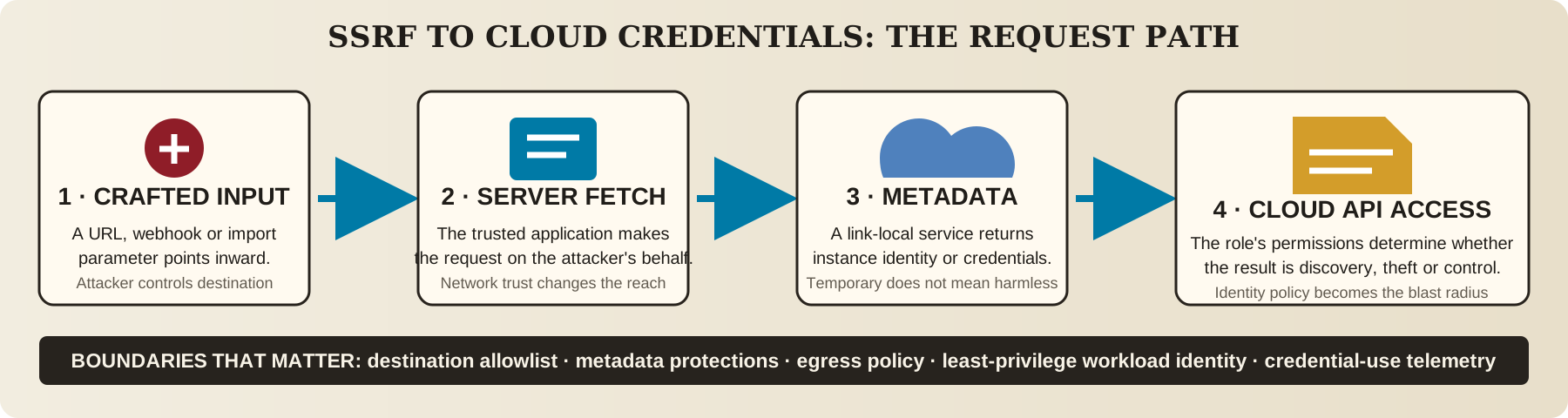 A server-side request forgery path from attacker-controlled input to a trusted application, cloud metadata, temporary credentials and downstream cloud APIs.
Server-side request forgery, usually shortened to SSRF, occurs when an attacker can influence a request made by the application server. The server may legitimately fetch a webhook URL, preview a link, import a file, retrieve a model or contact an integration. The vulnerability appears when the application accepts a destination it should not reach or can be redirected to one after validation.
The word “server-side” explains the security consequence. The request does not come from the attacker's browser. It comes from a system inside the organization's network or cloud account. Firewalls, allowlists and metadata services may treat that origin as trusted even though the attacker selected where it went.
Why cloud metadata is attractive
Cloud platforms expose link-local metadata services to workloads so software can learn about its instance and, where configured, obtain temporary credentials for an attached identity or role. The service is not intended to be reachable from the public internet. An SSRF-vulnerable application can become a proxy across that boundary.
Temporary credentials are preferable to long-lived secrets because they expire and can be issued automatically. They are not harmless. During their lifetime, they carry the permissions assigned to the workload identity. If the role can read model artifacts, storage buckets, experiment data or secrets, an attacker may exercise those permissions from another system.
This is what made the MLflow exploitation important. The model-registry webhook was not merely a networking feature. In a cloud deployment, its ability to make requests intersected with the identity assigned to the workload.
The four stages of the path
| Stage | Technical event | Investigative evidence |
|---|---|---|
| Attacker input | A URL or redirect is supplied to a webhook, import, preview or callback feature. | Application requests, parameters, user identity and validation decisions. |
| Server fetch | The application resolves and contacts the destination from its trusted environment. | DNS, proxy, egress, application and container telemetry. |
| Metadata response | A link-local endpoint returns instance details, tokens or role credentials. | Metadata-service controls, workload logs and unusual request paths. |
| Cloud API use | Retrieved identity material is used against storage, secrets, compute or another service. | Cloud audit logs, source address, session name, role assumption and object access. |
Validation is a sequence, not a regular expression
A destination can look acceptable when first parsed and become dangerous later. DNS can resolve a public-looking name to a private address. A permitted URL can redirect to a link-local endpoint. Alternate numeric formats, IPv6, user-information syntax or parser differences can cause two components to interpret the same text differently.
Strong handling resolves the destination, checks the resulting address against policy, limits redirects and revalidates every hop. Where the business function has a small known set of destinations, a positive allowlist is stronger than attempting to enumerate every forbidden network.
The application should also make outbound requests through a controlled egress layer. That creates a second decision point independent of application validation and produces telemetry when an unexpected service attempts to reach metadata, loopback, private ranges or a new internet domain.
Metadata protection and least privilege solve different problems
Metadata-service protections can require session-oriented tokens, restrict hop behavior or prevent access from untrusted network paths. Those controls reduce the likelihood that a simple request retrieves credentials. They do not correct arbitrary server-side fetching or excessive permissions.
Least-privilege workload identity reduces the consequence if credentials are returned. It does not prevent SSRF from reaching internal administrative interfaces or extracting other responses. The controls are complementary: one narrows the request path, another narrows what a successful identity can do.
SSRF can change state without returning a response
Some internal services accept actions through a request even when the attacker cannot read the body returned to the vulnerable application. A forged request might trigger a deployment hook, modify a setting or call an administrative endpoint whose protection assumes that only internal systems can reach it. This “blind” SSRF is harder to confirm from the attacker's perspective but may still leave DNS, proxy and service-audit evidence.
The distinction matters during testing. A scanner that reports only reflected response content can miss request paths that cause side effects. Conversely, an outbound DNS lookup proves that some server-side behavior occurred but does not by itself establish access to metadata credentials. Severity depends on the reachable service and the action the request can perform.
Reading the logs after an incident
An SSRF investigation crosses layers. Application logs show who supplied the destination. Network telemetry shows what the server contacted. Cloud identity logs show which role was issued or used. Service audit logs show which objects were listed, read or changed.
Time matters because credentials may expire before the incident is discovered. Expiration prevents future use but does not erase earlier access. Investigators should preserve the linkage between workload instance, issued role session, source address and subsequent cloud API calls rather than concluding that no active key means no exposure.
The MLflow case, layer by layer
The reported MLflow exploitation can be read as four separate control decisions. First, an unauthenticated caller could reach the model-registry webhook function. Second, the function accepted a destination capable of resolving toward cloud metadata. Third, the workload could contact that service and receive identity material. Fourth, the attached role carried permissions valuable enough to pursue.
No single correction answers every layer. Authentication would restrict who can create the webhook but would not make arbitrary destinations safe for a compromised account. Destination controls would stop the metadata request but would not reduce an overprivileged role. Metadata protection would narrow credential retrieval while leaving other internal services exposed. Least privilege would reduce impact while leaving the request-forgery defect intact.
This layered reading also prevents a common error in cloud incident reports: describing the application vulnerability as if it directly granted every permission later used. SSRF supplied a route. The workload identity supplied authority. Cloud audit evidence is needed to determine which authority was actually exercised.
Redirects and DNS make the destination move
A secure decision cannot end after checking the original text. An apparently public endpoint may respond with a redirect to a private address. A domain can resolve differently between validation and use. Services may follow several redirects automatically, and different URL libraries may disagree about encoded addresses or credentials embedded before an at-sign.
The stable policy is applied to the effective destination of every request. It resolves the host through a controlled resolver, rejects loopback, link-local and private ranges unless explicitly required, constrains protocols and ports, and repeats the decision after redirects. The egress layer then enforces a compatible rule even if application validation fails.
Where the model has limits
Not every SSRF returns credentials. It may disclose an internal status page, scan private services, invoke an administrative endpoint or send a request with the server's network identity. Conversely, not every cloud-credential theft begins with SSRF; exposed secrets, compromised CI systems and overly permissive notebooks can produce the same later stages.
The concept is useful because it separates three questions: who selected the destination, which system made the request and what authority accompanied that system? In cloud incidents, those may refer to three different identities.
The response must reconstruct the complete request chain
An SSRF investigation starts with the public request but cannot end there. Application logs identify the parameter or webhook supplied by the attacker. Resolver and proxy records show the destination ultimately reached. Metadata-service and identity logs show whether credentials were issued. Cloud audit trails then establish whether the resulting session read objects, listed secrets or changed another service.
Missing evidence at one layer should narrow the conclusion, not be converted into proof of no impact. A blocked response may still have triggered a state-changing request, while an issued credential may have expired without ever being used. The chain distinguishes attempted routing, successful retrieval and exercised cloud authority.