Evolve on Sundays: Supply-Chain Attacks, Cloud Security, and AI’s Expanding Cyber Capabilities
A technical recap of registry and update hijacks, identity failures, covert malware, Fire Ant espionage, and court and healthcare data breaches—alongside AWS, CrowdStrike, and Cloudflare developments, frontier AI safeguards, and NVIDIA’s Hugging Face acquisition agreement. Detailed incident reconstruction, verified expert commentary, and the limits of the available evidence.
 Coder disclosed that a compromised Cloudflare API key let an attacker redirect part of its module-registry traffic to tampered Terraform artifacts. Official image: Coder.
Security, software, and technical intelligence for the week ahead.
Coverage window: Sunday, August 30 through Saturday, September 5, 2026, with final editorial verification on Sunday morning, September 6.
The week's most consequential incidents began in systems that other systems were designed to trust. Coder's registry delivered tampered infrastructure modules after an attacker changed the network path behind it. A weakness in Lenovo's identity verification reportedly became a route into Dropbox accounts. Two exploited SonicWall vulnerabilities turned a remote-access appliance into the point of entry it was meant to defend. A Chrome flaw reached users through the browser's JavaScript engine, while a healthcare archive and a court-management provider concentrated records belonging to many separate institutions.
That pattern matters more than any one product name. When software distribution, federated identity, remote access, or centralized data processing fails, the compromise crosses organizational boundaries through connections that were authorized in advance. This edition separates confirmed vendor and government findings from media reporting, legal allegations, and editorial analysis. Primary notices accompany the material claims wherever they are publicly available.
Editorial methodology: Evolving Cyber prioritizes vendor advisories, government releases, regulatory decisions, court notices, and original technical research. A disclosure published this week may concern an older intrusion; the date of the underlying event is stated so new reporting is not mistaken for new compromise.
01Security Headlines
Coder registry hijack exposes provisioning credentials
An unchanged registry hostname delivered attacker-controlled modules to some customers. Official image: Coder.
Between 07:35 and 21:45 UTC on August 31, an attacker used a compromised Cloudflare API key to redirect part of registry.coder.com's traffic to a malicious server. Customers requesting legitimate Terraform modules could receive modified artifacts designed to search for cloud credentials and send them to coder-infra.com. In its September 4 account, Coder says its codebase and Google Cloud infrastructure were not compromised. It removed the malicious destinations and cleared its cache that day. Coder's incident account.
Coder distinguishes two execution contexts. Template uploads, updates, and dry runs exposed secrets on the provisioner itself, without passing user secrets into the job. Workspace builds additionally supplied user OIDC tokens, configured SSH keys, and relevant external-auth tokens. The company specifies that refresh tokens were not included. An embedded provisioner could also expose coderd configuration, including database credentials. These are configuration-dependent exposures, not confirmed theft of every listed secret.
Coder's security advisory states that “we do not have the ability to conclusively determine which users may have been affected.” Requests reached the attacker's server, outside Coder's visibility. The advisory links cached modules to template versions and workspace builds, and calls for egress review, cache removal before redeployment, and credential rotation. Listed patched releases are 2.37.0, 2.36.4, 2.35.7, and 2.34.9. Coder's technical advisory.
Caching helps explain why downloading and building were not equivalent exposure events. Coder says module caching is enabled by default: creating a template or template version commonly triggers a download, while workspace creation can fetch modules when caching is disabled. Its September 4 announcement described the upstream registry as clean; the separate customer guidance still addressed artifacts already held inside deployments. Coder's incident account.
HashiCorp documents that Terraform's dependency lock file tracks providers, not remote modules. Pinning a module version therefore does not give it provider-checksum verification. For providers, Terraform rejects packages that do not match previously recorded checksums—a trust-on-first-use model whose initial acceptance determines subsequent checks. Terraform dependency-lock documentation.
Neither account establishes customers' additional integrity controls or explains how the attacker initially obtained the Cloudflare API key. Coder's disclosure.
SonicWall: SMA1000 exploitation triggers recovery guidance
 The September 1 notice requires both an upgrade and a support-assisted compromise review. Official image: SonicWall.
On September 1, SonicWall confirmed active exploitation of CVE-2026-83548, pre-authentication SSRF through an unintended forward proxy, and CVE-2026-83549, post-authentication remote code execution. The affected SMA1000 models are 6210, 7210, and 8200v. The listed vulnerable builds are 12.4.3-03453 and 12.5.0-02835; corrected hotfixes are 12.4.3-03526 and 12.5.0-02952. This notice is specific to SMA1000, not the SonicWall portfolio generally.
MS-ISAC's September 2 advisory says chaining the flaws “could allow for remote code execution, potentially leading to full system compromise.” It locates the SSRF in the Work Place interface and the command-injection flaw in the Appliance Management Console, where exploitation requires administrator authentication under specific conditions. This describes the chain's potential, not a published reconstruction of a victim's intrusion. MS-ISAC technical assessment.
SonicWall requires affected deployments to upgrade and contact support for compromise review. If indicators are found, it directs hardware re-imaging or virtual redeployment, all user and administrator password changes, and TOTP resets. Its public notice does not identify an actor, victim count, or intrusion dates. SonicWall product notice.
Chrome patches exploited V8 flaw
 Google's September 3 desktop release includes the fix for CVE-2026-85046. Official image: Google.
Google's September 3 desktop update fixed CVE-2026-85046, a high-severity V8 type-confusion flaw reported by Salvatore Gulizia on August 4. Google says an exploit exists in the wild. The corrected release is 152.0.7977.82/.83 on Windows and macOS and 152.0.7977.82 on Linux, with 12 security fixes overall.
Google does not name a campaign, describe targeting, or disclose a companion sandbox escape. August 4 is the reporting date, not a known exploitation start date. The vulnerability class alone does not establish full host compromise. Release notice.
In its April 2024 sandbox design account, V8's engineering team wrote that “memory safety cannot be guaranteed by the compiler if a compiler is directly part of the attack surface.” A memory-safe JIT implementation can still generate unsafe machine code through faulty optimization logic, the team explained. Its heap sandbox aims to contain the resulting corruption. This is architectural background, not a finding about CVE-2026-85046's undisclosed exploit. V8 engineers' explanation.
02Botnet Disruption & Data Headlines
Sality disruption turns a resilient peer network against its operator
 A coordinated sinkhole operation manipulated Sality's peer lists and cut infected systems off from new tasking. Official image: CrowdStrike.
An August 31 operation targeted both Sality's peer-to-peer network and the domains supplying its malware. The Justice Department's September 1 announcement describes domain seizures in the United States and action against additional domains in Bulgaria, Hungary, and Romania, alongside a sinkhole operation involving CrowdStrike, the FBI, DCIS, and other partners. Shadowserver is working with internet providers and incident-response teams on victim notification and remediation. Sality has operated since 2003. Justice Department announcement.
CrowdStrike's Counter Adversary Operations team identifies the protocol weakness directly: “Sality bots trusted the network without verifying who was in it.” A reachable machine completing the handshake could join without cryptographic peer identity. Bots checked their finite lists of super peers approximately every 40 minutes, increasing or reducing reputation according to availability. Defenders manipulated that maintenance process to remove genuine super peers and substitute sinkholes. CrowdStrike's technical account.
The team says two incompatible protocol networks remained active, sharing a codebase but using different keys. Its operation targeted reachable super peers first; machines behind NAT or firewalls were isolated when they contacted sinkholes. Separate payload-URL takedowns blocked downloads from instructions already circulating during the transition. That addressed both new tasking and previously distributed download locations.
CrowdStrike reports a network exceeding 33,000 infected machines, but distinguishes disruption from cleanup: existing malware remains active on hosts even after new payload delivery stops. Its published detection material includes network indicators and memory-scanning rules. The claimed result is loss of the operator's command channel, not automatic repair of every infected endpoint. Operation findings and detection material.
Dropbox account access traced to a legacy Lenovo identity integration
Dropbox identified unauthorized account access between August 4 and 21, according to a September 2 report by BleepingComputer. A flaw in Lenovo's email verification let an attacker register a Lenovo ID with someone else's email address and use it to enter the corresponding Dropbox account. Some affected people had never created a Lenovo ID. The reported path therefore did not depend on stealing their existing Dropbox passwords. BleepingComputer's reporting and reproduced customer notice.
In a statement to the publication, Lenovo described a legacy integration that could be used “to improperly authenticate certain Dropbox accounts.” The report says Dropbox expired sessions authenticated through Lenovo IDs and required the Dropbox password for subsequent Lenovo-ID sign-ins. Those changes addressed both existing sessions and the alternative authentication route.
The publication, citing Reuters, reported approximately 5,000 accounts accessed, with content viewed or downloaded from some accounts. That figure measures account access, not a confirmed count of accounts with downloaded files. Lenovo said its own customers were unaffected and the investigation continued. The companies had not publicly identified an attacker. Company response and reported scope.
Account linking is a separate security decision from authenticating an incoming identity. Auth0's guidance says implementations should “request authentication for both accounts before linking occurs.” Its documented suggested-linking flow uses matching email addresses to identify candidates, then authenticates the account being linked. The match proposes a relationship; it does not establish control of both identities. This is implementation background from an identity-security provider, not a claim that Dropbox used Auth0 or that Auth0 investigated the incident. Auth0's account-linking security guidance.
Aesto's archive breach: December intrusion, May data confirmation
 Aesto provides healthcare data migration and archiving services to covered entities. Official image: Aesto Health.
Background case—not a new breach this week. Aesto Health's June 24 notice describes unauthorized activity discovered around December 18, 2025, in part of its AWS infrastructure. The healthcare migration and archiving provider says forensic investigation and manual document review established on May 26, 2026 that patient information may have been accessed or acquired during December 2–18. Notifications to affected healthcare clients began June 26. Aesto's incident notice.
The dates describe different stages: detecting unauthorized activity, determining the information involved, and notifying clients. The records belonged to patients of multiple healthcare organizations, rather than a single hospital. Potential fields included medical and insurance information, dates of birth, government identifiers, financial-account numbers, and some Social Security numbers; exposure varied by person.
Aesto states: “We have no evidence of any identity theft or financial fraud related to this incident.” That statement concerns observed misuse, not a finding that records were never accessed. The notice does not disclose an initial-access mechanism or attribute the intrusion. Its reference to AWS identifies the affected hosting environment; it does not establish a vulnerability in AWS itself. Company findings and limitations.
FinCEN maps $12.7 billion in suspected scam activity and its service economy
FinCEN's September 3 release links approximately $12.7 billion in suspected digital-asset investment scam activity to 33,904 Bank Secrecy Act reports filed between September 8, 2023, and December 31, 2025. The agency describes industrial-scale fraud operations using fabricated relationships and imitation investment services, supported by criminal organizations largely based in Southeast Asia. FinCEN announcement.
Its analysis cautions that institutions usually see only “a snapshot of different phases in a scam's lifecycle.” Reports were selected by filing date, not incident date, and amounts can include attempted transactions, both sides of transfers, continuing reports, duplicates, and errors. The total is therefore reported suspicious financial activity, not an audited sum stolen from unique victims. Financial Trend Analysis, methodology.
The report distinguishes two payment paths. In one, victims purchase digital assets through accounts they control, then transfer them to scammer-controlled addresses. Institutions may not see the theft at the purchase stage because the customer still controls the assets. In the other, victims send ordinary currency to scam-linked accounts while an app or website portrays the transfer as an investment; the victim never takes custody of digital assets. The displayed investment balance and the actual movement of funds are separate parts of the deception. FinCEN's transaction analysis.
FinCEN also describes a supporting market for account creation, phishing, and laundering services. Operators buy these capabilities through online guarantee marketplaces; professional launderers establish financial accounts and shell companies, then move proceeds through money-mule networks and stablecoin transfers to overseas exchanges. This separates the person cultivating the victim from the infrastructure and financial services sustaining the operation. FinCEN's description of the criminal service ecosystem.
The accompanying September 3 alert explains what the marketplaces guarantee: they typically hold payment in escrow until delivery is confirmed, and may offer dispute resolution or insurance funded by vendor deposits. Often organized through Telegram groups and bots, they provide transaction infrastructure as well as advertising. FinCEN also describes nested exchanges that pool customer deposits in accounts at larger exchanges, adding an intermediary between the underlying activity and the host provider. Its requested evidence connects these layers: scammer usernames and chat logs, destination domains, wallet addresses, and transaction hashes. The agency cautions that no individual red flag establishes illicit activity; surrounding transactions and customer history matter. FinCEN's scam-center alert, marketplace mechanics and financial indicators.
03Fal.Con — AI Security
NVIDIA and CrowdStrike test an attack–defense AI loop
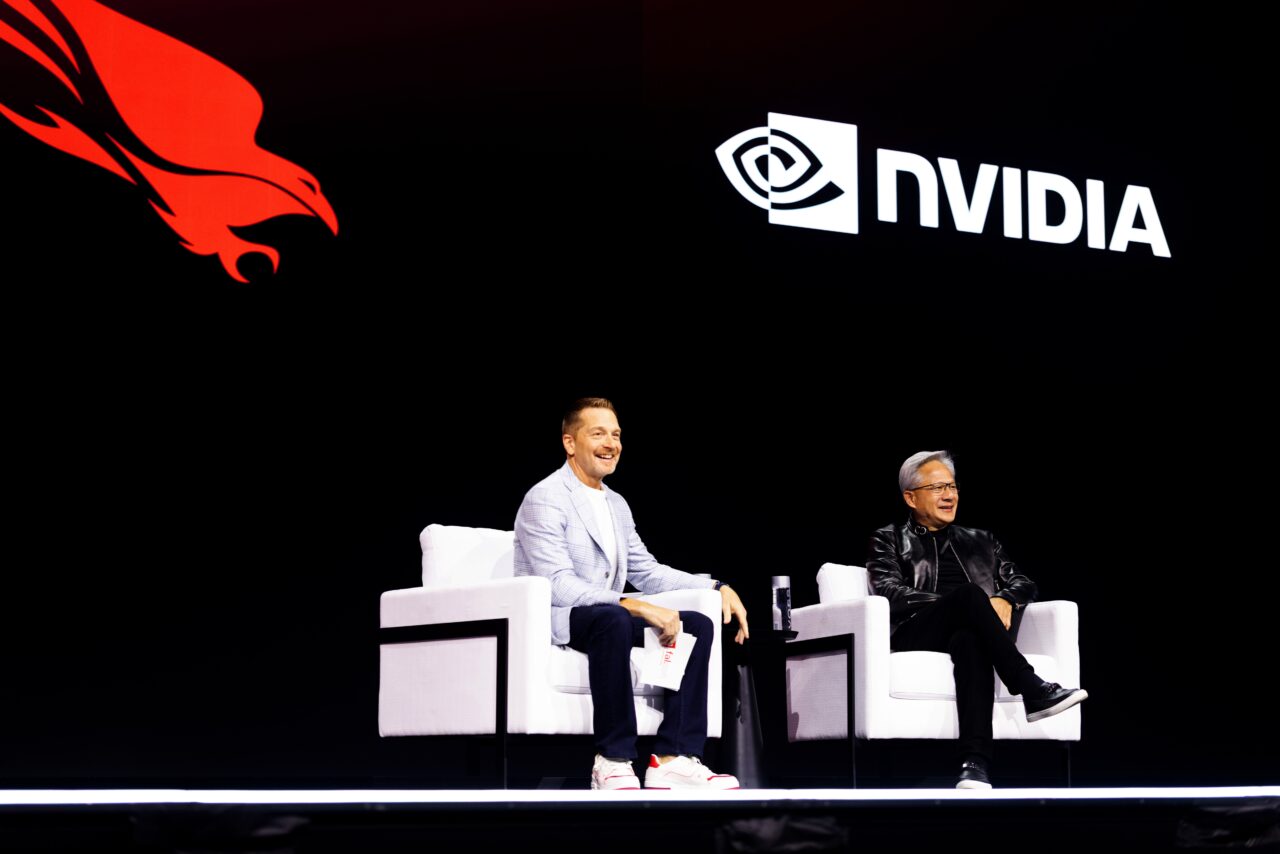 NVIDIA's Jensen Huang joined CrowdStrike's George Kurtz at Fal.Con in Las Vegas on September 1. Official photograph: NVIDIA.
CrowdStrike's September 1 SafeMind announcement connects two activities usually separated by operational handoffs: generating an attack and engineering a detection for it. Its Red Tempest offensive model and Blue Solano defensive model work through specialized agent harnesses, repeatedly testing weaknesses and strengthening defenses. NVIDIA is the AI design partner; CoreWeave supplies training and inference infrastructure. CrowdStrike says training draws on Falcon telemetry, threat intelligence, managed-response annotations, and incident-response experience. CrowdStrike's SafeMind announcement.
“The harness is essentially the exoskeleton of the large language model,” NVIDIA CEO Jensen Huang explained on stage. Here, that surrounding software gives models the tools and execution context to perform security work. NVIDIA describes Nemotron 3 Ultra orchestrating the defensive workflow, with a fine-tuned Nemotron 3 Super handling rule generation. The companies tested the system in an isolated representation of NVIDIA's accelerated-computing infrastructure—not by releasing autonomous attackers into customer production networks. Offensive sub-agents perform reconnaissance, assault, and compromise; the defensive side observes Falcon sensor evidence and generates, validates, and promotes detection candidates. NVIDIA's account of the collaboration.
The engineering detail behind the demonstration
NVIDIA researchers Roberto Rodriguez and Neha Hudait describe checks that reject invented telemetry fields, invalid queries, and rules hard-coded to particular hosts or addresses. Candidates must replay successfully against recorded attacks and pass a separate review. This tests whether a generated rule actually detects behavior, rather than merely looking syntactically plausible.
Their live-fire evaluation used eight unseen attacks from one scenario family. Five of 11 passing open-model detections generalized to at least one attack, versus 10 of 35 from the frontier-model system. Three open-model detections passed the additional quality gates and collectively covered all eight attacks; none from the comparison system passed every gate. But the authors explicitly call this “a directional system-level case study, not a general benchmark.” Benign traffic was limited, so the noise test does not establish production false-positive rates. Three runs suffered harness failures but retained complete telemetry and remained in the evaluation. Changing both the harness and model stack also prevents attributing the improvement to the model alone. NVIDIA's technical evaluation and limitations.
CrowdStrike separately advertises 29% higher detection, sixfold faster remediation, and 99% cost savings against its selected baselines. These are vendor evaluation claims, not independently established fleet-wide outcomes. Its release says SafeMind will operate natively in Falcon and standalone access will be offered through Project QuiltWorks; that wording does not establish universal customer availability at publication. Reported results and access plans.
Guardian traces prompts to system actions
CrowdStrike's other September 1 launch concerns agents that enterprises deploy, rather than agents defending them. Falcon Guardian connects agent activity to endpoint telemetry, aiming to reconstruct the path from a user's prompt and identity through tool calls and skills to downstream execution. The announced inventory covers running and dormant agents on Windows and macOS, including unapproved deployments and who installed them. Guardian announcement.
“Governance alone can’t stop an agent already in motion,” CEO George Kurtz said. The described controls allow organizations to decide which agents may run, block unauthorized agents, and investigate malicious behavior using the execution chain and affected systems. Agent data also feeds Falcon's SIEM for correlation with identity, cloud, and SaaS activity. This is an endpoint-led visibility and enforcement design; the announcement's broad coverage claims are the company's claims, not results of an independent coverage test.
Two elements are expressly prospective: an AI Gateway for supported model and service traffic, including MCP, and Falcon Complete for Guardian, a managed investigation-and-response service. The release describes what those services will provide; it should not be read as confirmation that every announced component is already deployable. Runtime controls and planned services.
Agentic IdP brokers temporary access
On September 2, CrowdStrike introduced Agentic Identity Provider, linking Guardian's discovery to a directory that registers agents and issues cryptographically verifiable identities. Access is then brokered through short-lived, narrowly scoped tokens, rather than giving each agent permanent credentials. The design binds actions to the person or workload on whose behalf the agent operates. Agentic IdP announcement.
Scott Kriz, CrowdStrike's general manager of Continuous Identity, explained the dependency: “you cannot continuously authorize an identity you were never able to establish.” Establishing the agent and deciding its current permissions are separate steps. CrowdStrike assigns the latter to Continuous Identity, which it describes as risk-aware authorization that grants and withdraws access as circumstances change.
The release does not specify token lifetimes, supported federation protocols, or how delegated sub-agents preserve attribution across organizational boundaries. It also includes an unreleased-features disclaimer. Those details remain unresolved in the public announcement; the proposed architecture is more specific than a general promise to secure agents, but is not an interoperability specification. Identity lifecycle and disclosure limitations.
Falcon IQ automates partner assessments
The conference announcements began August 31 with Falcon IQ, a partner-facing workflow layer built on Falcon Foundry and Charlotte AI AgentWorks. CrowdStrike says more than 50 agents combine customer telemetry, threat intelligence, and OverWatch findings to produce attack narratives, investment priorities, and remediation roadmaps. NVIDIA Nemotron powers the agentic engine; partners can build and tune agents for individual engagements. Falcon IQ launch.
Partners upload their service catalogues, and recommendations map customer exposures to those services or Falcon configuration and module changes. A co-branded dashboard tracks findings and remediation progress. That commercial context matters: this is an assessment-and-delivery system within a vendor and partner ecosystem, not a vendor-neutral audit.
The underlying QuiltWorks coalition combines vulnerability discovery and prioritization with integrator remediation, AWS infrastructure, and cyber-insurance participation. Falcon IQ productizes that workflow; it is distinct from SafeMind's attack–defense testing system and Guardian's runtime controls. The launch release also cautions that unreleased features remain subject to change. Workflow, ecosystem roles, and release caveat.
Falcon intercepts packages before scripts run
CrowdStrike's September 2 supply-chain release adds a separate control point: package downloads. Its technical explanation says the existing Falcon sensor intercepts package-manager transactions, checks suspicious files against adversary intelligence, and quarantines matches before embedded setup scripts execute. Coverage described includes npm and PyPI activity on Windows, macOS, and Linux. Technical explanation by Anne Aarness and Chris Prall.
When a package is newly identified as compromised, the platform also searches historical enterprise data for prior exposure and triggers containment workflows on matches. This distinguishes blocking an incoming dependency from discovering that the same package already reached other machines. The authors emphasize that agent-driven package installation extends exposure beyond traditional developer workstations.
The release schedule is staggered. CrowdStrike describes real-time protection as enabled through the existing sensor, while global package inventory is scheduled for Q3 and proactive policy controls for Q4. Those future controls include minimum package age, restrictions on public packages, and fallback to approved versions. Cooldown policy is therefore a planned additional safeguard, not a feature the announcement establishes as available today. Detection mechanics and rollout schedule.
04Attack Anatomy — Hijacked Updates
Virtualizor's hijacked update route returned after an eleven-hour lull
Disclosed August 31; interception occurred August 28–30. Virtualizor says traffic to Softaculous update and billing infrastructure was diverted after an unauthorized announcement of 162.55.80.0/24, within Hetzner's legitimate /16. The attacker also obtained a valid Let's Encrypt certificate by intercepting domain-control validation. Update clients did not cryptographically verify packages, allowing malicious content through without a certificate warning. The vendor confirms a small number of affected installations, but cannot enumerate them from requests that never reached its servers. Virtualizor's incident report.
The published timeline is not one continuous outage. Diversion began around 20:57 UTC on August 28. Hetzner's own /24 announcement suppressed it around 08:50 on August 29, followed by roughly eleven quiet hours. The unauthorized route returned around 20:00, reopening interception until normal routing was restored around 06:10 on August 30. Route flapping made individual networks' exposure intermittent. BGPHorizon's routing chronology. Collector visibility measures route propagation—not how many updates completed or how many servers were compromised. Vendor measurement limits.
Why the forged route still passed origin validation
BGPKIT's Mingwei Zhang reconstructed the routing evidence from RIPE RIS and Route Views archives. The observed path ended 6204 → 62390 → 24940: transit AS6204, NexonHost's AS62390, then Hetzner's genuine origin AS24940. Retaining that authorized origin, while inserting an unauthorized preceding relationship, let the route pass origin validation. Zhang verified a covering route-origin authorization permitting AS24940 to announce the /16 down to a maximum prefix length of /24. The malicious announcement satisfied both checks.
Zhang writes that “the forged information was the relationship immediately before the origin.” His finding is narrower than saying RPKI failed to authenticate a forged signature: origin validation did not authenticate the intervening path. The /24 then attracted traffic over the less-specific legitimate route wherever accepted. Zhang separates collector-verified routing from vendor-reported malware findings; the AS path identifies infrastructure carrying the announcement, not the individual controlling the attack. His reconstruction also cautions that routing timestamps cannot establish whether the second wave was deliberately timed around the withdrawal of Hetzner's countermeasure. BGPKIT's primary-data reconstruction.
Certificate issuance: the unresolved validation detail
Technical background, not a new announcement: Let's Encrypt introduced multi-perspective validation in 2020 specifically to make routing attacks on certificate issuance harder. Josh Aas, Daniel McCarney, and Roland Shoemaker explained that an attacker redirecting validation traffic could otherwise satisfy a challenge without controlling the legitimate service. Checking from multiple network locations raises the number of paths an attacker must influence. Let's Encrypt's explanation.
Virtualizor reports that validation was intercepted, but its disclosure does not identify the validation perspectives or explain their individual results. It therefore establishes the vendor's account of a misissued certificate, not a complete explanation of how the CA's multi-perspective defenses behaved in this incident. Restoring routing and investigating certificate issuance are distinct parts of the response.
A hosting provider identifies five affected hypervisors
AlbaHost's security team supplies a concrete customer-side finding: its investigation identified the malicious package on five of 34 hypervisor nodes. The other 29 showed no known indicators at the time of its notice. The provider says it isolated affected nodes, removed identified unauthorized access, reset and restricted Virtualizor API credentials, and began rotating other infrastructure credentials. Complete rebuilds from clean installation media were planned for all five affected hypervisors. AlbaHost's incident notice.
The team states it had “not found confirmed evidence that individual customer VPS instances were accessed or modified.” That is a limit on confirmed findings, not a guarantee about every guest: the same notice says the affected software executed with root-level access. Its five-node count describes one provider's fleet, not the global incident. Investigation and rebuild work were still ongoing when the notice was published.
Softaculous separately says it found no evidence of compromise in its other products and was invalidating client-area sessions. It explicitly distinguishes domains whose traffic could have been diverted from products confirmed compromised. Softaculous's scope clarification. Virtualizor's September 1 Patch 9 release added an administrative Security Analyzer; the incident notice still described package signing as planned. The published host indicator is java-jre-update.service. Release notes · Incident response status.
Coder: the cache outlived the compromised registry route
A legitimate registry hostname became the entrance to an unauthorized server pool. Official image: Coder.
Follow-through to the page-one report. Coder's September 4 account says a compromised Cloudflare API key redirected some registry traffic between 07:35 and 21:45 UTC on August 31. It removed malicious destinations and cleared its cache that day, without finding compromise of its codebase or Google Cloud infrastructure. That restored the upstream service; it did not establish what customer deployments had already downloaded. Module caching is enabled by default, so template creation and workspace execution need not contact the registry at the same moment. Coder's incident account.
What the investigation queries actually establish
Coder's advisory links cached module-file timestamps to template versions, then to associated workspaces. That identifies potential exposure to downloads inside the window, not proof of successful exfiltration. A separate provisioner-log query searches for data.external.telemetry, the Terraform block associated with the malicious script. This route through job logs also addresses dry runs and deployments with module caching disabled. The published indicators include several dlp.sh variants and dlp-docker.sh, with distinct hashes. Coder's technical advisory.
Execution context determined reachable secrets. Template operations exposed the provisioner's environment; workspace builds additionally passed user OIDC tokens, configured SSH keys, and relevant external-auth tokens—not refresh tokens. Running the provisioner inside coderd could also expose service configuration, including database credentials. These are possible exposures, not confirmation that each secret was stolen. Coder's remediation combines local cache removal before redeployment with credential rotation; its listed corrected releases are 2.37.0, 2.36.4, 2.35.7, and 2.34.9. No customer-wide victim count is established. Exposure scenarios and remediation.
Version selection was not content authentication
HashiCorp's Terraform documentation makes a consequential distinction: its dependency lock file records providers, not remote modules. An exact module-version constraint fixes the requested version, but does not give the downloaded archive the provider-checksum checks described for the lock file. For providers, Terraform compares installed packages with recorded checksums and rejects mismatches. HashiCorp describes initial acceptance as trust on first use. Terraform's dependency-lock behavior.
The distinction explains why an unchanged module name or pinned version cannot, by itself, resolve the Coder exposure question. It does not establish that any particular customer lacked additional verification; those deployment-specific controls are not described in the public incident account.
An agent transcript is not a network audit trail
In a September 4 analysis published by Bromure, security researcher Renaud Deraison distinguishes an AI agent's recorded tool calls from network operations performed by subprocesses those tools start. A shell script inside a Terraform module can communicate without that connection appearing in the model's transcript. “Either something recorded the request as it left the machine, or there is nothing to search,” he writes. Deraison's analysis.
That is an explanation of an evidence gap, not a finding that every Coder customer lacked logs. Deraison's article also promotes Bromure's own isolation and egress controls; those product claims are not independent incident evidence. Coder itself directs customers to firewall, proxy, DNS, and VPC flow records for coder-infra[.]com, because it cannot inspect the attacker's server logs. The public account still does not explain how the API key was initially obtained. Coder's findings and customer-side evidence.
05Attack Anatomy — Covert Command Channels
EtherHiding adds a browser data channel to blockchain delivery
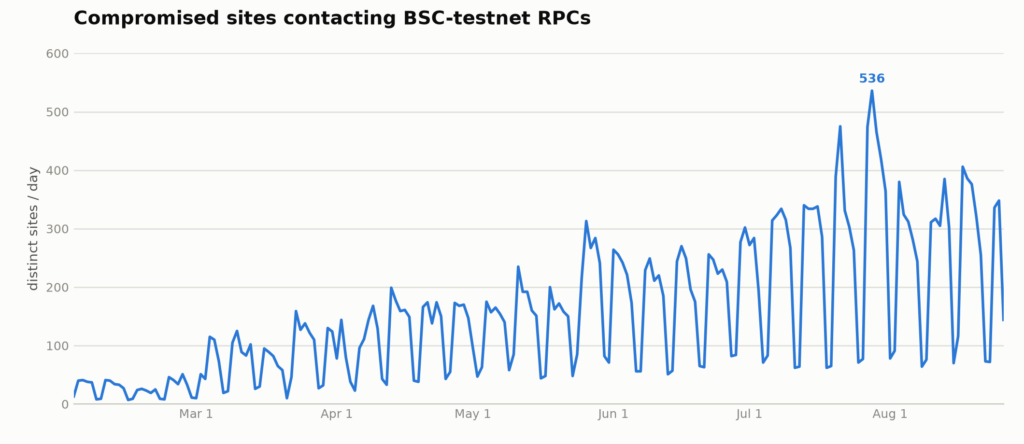 Netskope's site telemetry spans months, not one week's infections. Chart: Netskope Threat Labs.
September 3 research; observations span months. Netskope's John Carlo Marquez reports more than 5,400 compromised websites retrieving malicious JavaScript from BNB Smart Chain testnet contracts. Initial website compromise remains unexplained. A loader's eth_call retrieves the next stage; changing the contract changes subsequent delivery. One branch displays a ClickFix overlay asking users to execute a command. Another uses WebRTC. The site count does not measure compromised visitor devices. Marquez's investigation.
In the WebRTC sample, the script generates an offer but supplies its own answer using predetermined peer details, including ICE credentials and a DTLS fingerprint. Buffered code runs on channel closure or a ten-second timeout. The stager copies a legitimate script's nonce onto its injected script element, then removes the element. Marquez cautions: “The final payload is not fixed.” Browser execution does not establish operating-system compromise. Observed execution chain.
Signaling bypass is not a broken encryption protocol
Protocol context: Eric Rescorla's RFC 8827 separates application signaling, ICE consent, and DTLS establishment; data channels use SCTP over DTLS. A predetermined answer removes an application-level exchange, not transport key establishment. A certificate fingerprint is not an encryption key. Netskope's handshake-bypass language therefore does not demonstrate broken DTLS. The page fetch and peer channel are separate communications: an HTTPS proxy record of one does not describe the other. Encryption can protect an attacker-controlled peer's traffic without making the directing application trustworthy. RFC 8827, sections 4.1–4.3.
The nonce was reused, not guessed
The W3C requires fresh, unpredictable CSP nonces but warns that access to an accepted nonce permits script execution. Freshness prevents prediction across responses; it does not authenticate code already operating in the document. This stager reused an available nonce, not a cryptographic break. The finding does not generalize to every CSP-protected site. CSP Level 3.
Toy Ghouls uses messaging rooms as a command interface
Published September 4; first observed in early July. Kaspersky GERT identifies two custom Windows backdoors used by Toy Ghouls against Russian organizations: mqtt-bird-agent and matrix-bird-agent. Delivery used WinRM on already compromised systems. Both can run interactively or persist as services; this is not a disclosed WinRM initial-access vulnerability. Kaspersky's original research.
The HiveMQ variant receives commands and invokes PowerShell, returning output, errors, and exit status. The Matrix variant uses the attacker-controlled meet.element[.]tw server: room messages carry device status, metrics, and commands. Investigators recovered the command-sending account panel-bot from local Element SQLite databases. This is evidence of a specific operational channel, not proof that the legitimate Element or HiveMQ platforms were themselves breached.
Configuration is protected with ChaCha20-Poly1305 using a key derived from the host's MachineGuid. After first execution, the Matrix variant deletes its configuration file and stores sealed configuration in the registry. Failed decryption stops execution. Consequently, the on-disk state changes after installation; the original configuration file is not the only place the operational settings reside. Installation and communications findings.
What the host-bound configuration changes
In a September 4 commentary, CyPro partner and CISO Jonny Pelter explains that moving the configuration away from the original host can complicate analysis without its associated system information. His interpretation connects the machine-derived key to an investigative limitation: an executable and configuration copied elsewhere may not reproduce the behavior seen on the affected machine. Pelter's technical commentary.
Pelter also distinguishes malware version strings from affected product versions: this is not a vulnerable release range for HiveMQ, Matrix, or Element. He notes Russian targeting without established UK victims.
Kaspersky recovered distinct control messages: config:set_interval sets telemetry frequency between five seconds and one hour, persisting it in the registry; cmd: executes Windows shell commands, returning m.bird.cmd_response events. Telemetry and interactive commands share a room but leave different message-level artifacts. Recovered protocol.
Ted backdoor hides inside the load balancer's normal work
New to this edition: September 4 research on older activity. Rapid7 Labs describes a Linux toolkit targeting South Korean media and automotive organizations. Its ted backdoor was compiled into a victim's HAProxy 2.8.12 build, using native HTTP filters and internal scheduling while legitimate load balancing continued. This is a trojanized installation, not evidence that the upstream HAProxy release was malicious. Rapid7's investigation.
The implant reads decrypted HTTP structures, captures selected traffic and cookies, and can inject scripts into responses. Command requests terminate inside the load balancer rather than reaching an application backend. Rapid7 also found code altering connection counters to conceal activity. A companion curlRAT, embedded in trojanized system software, monitors HAProxy's health and normally polls for commands every twelve hours, with a thirty-second operator-enabled mode.
Ted extracts request-body blocks into FIFO pipes keyed to HAProxy's connection ID, then clears the request channel's forwarding and buffer fields. Rapid7 explains: “The C2 request terminates at the load balancer, and no backend ever logs it.” This is consumption inside the proxy, not simply deletion of an application log afterward. Request interception analysis.
The installation chain also changes trusted system software. Rapid7's stager checks for root privileges and profiles the OS before replacing crond and restarting its service; deployment requires HAProxy or cron to be running. Embedded payloads cover CentOS 7.7–7.9 and Ubuntu 22.04. It then aligns the replacement's timestamp with /usr/bin/ssh and selectively removes installation-related entries from shell history and system logs. These are post-compromise persistence and concealment steps, not evidence of how root access was first obtained. Stager analysis.
Earliest VirusTotal uploads date to mid-2025; those timestamps do not establish intrusion dates. Rapid7 assigns medium confidence to DPRK attribution. Its researchers state that evidence does not establish the initial entry point or associated CVE: the illustrated groupware-exploitation step is a hypothesis. The report supplies indicators and detections, not a completed victim-recovery account. Mechanism, chronology, and attribution limits.
NodeStealer splits stolen data across two Telegram bots
New to this edition: September 2 findings from August samples. Netskope researcher Jan Michael Alcantara reports a Python NodeStealer variant with keylogging, clipboard monitoring, and screenshot capture. Keylogs are sent every 120 seconds before their local contents are cleared. The observed targeting was concentrated in Asia and North America, led by financial services. Netskope's sample analysis.
Two Telegram bot tokens separate the collection paths: one receives the archive of browser credentials and cookies, while another receives Facebook-specific data. Alcantara proposes operational specialization or redundancy as possible explanations, not confirmed operator intent. The code attempts more than twenty Graph API queries, expanding beyond earlier account-focused collection into identity, social, security, and commerce fields. Requested fields are not proof that every API call succeeded for every victim.
The capture functions have different lifecycles. pynput records keystrokes to a temporary file while a separate thread transmits it; pyperclip collects clipboard text tagged with the victim's IP address. pyautogui takes screenshots at the beginning and end of the capture function. Netskope describes two snapshots, not continuous screen recording. Collection implementation.
Netskope suspects AI assistance because newly added functions share uniform structure and decorative emoji labels absent from older code. Those are stylistic indicators, not verified model provenance. The observed collection functions and split exfiltration are the concrete findings; the development method remains an inference. Capabilities and researcher's interpretations.
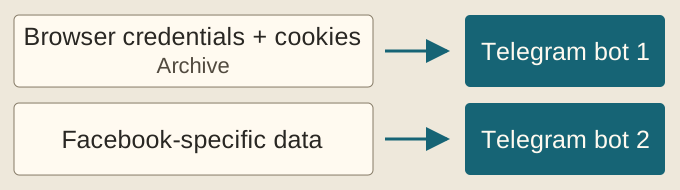 Diagram: Evolving Cyber, from Netskope's sample analysis. Separate bots do not establish separate operators.
06Attack Anatomy — Invisible-Character Phishing
The email looks ordinary; the detector may receive a different word
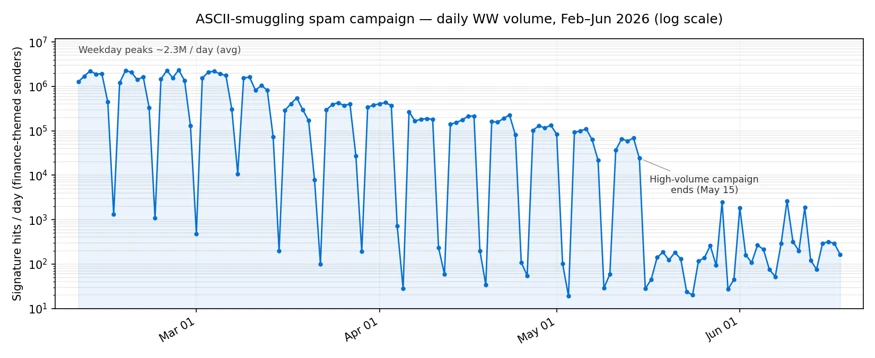 Microsoft's log-scale chart counts signature hits, not compromised recipients. Weekend troughs punctuate the February–May high-volume phase.
September 3 research on older activity. Microsoft's Noam Kochavi and Sarah Wolstencroft describe financial-lure mail that placed U+E0020, an invisible TAG SPACE, inside words: funding became fun⟨U+E0020⟩ding. Their prompt-injection hunt found filter evasion, not concealed instructions for an AI assistant. Literal matching can miss the interrupted word; normalization before tokenization changes that outcome. Microsoft's investigation.
Signature hits rose from approximately 21,000 on February 8 to more than 1.3 million on February 9. High-volume use fell sharply after May 15; the broader campaign continued without this technique. Microsoft reports that other protection layers flagged over 99% of messages. Its stack also uses OCR over rendered content.
ActiveCampaign, whose sending infrastructure was abused, told Microsoft that obfuscated messages receive “the same moderation verdicts as their unobfuscated equivalents.” That is the provider's reported test result, not an independent efficacy measurement. Shared tracking domains alone do not identify malicious mail. Telemetry and provider response.
Microsoft separated visible P2 sender domains, P1 envelope senders, and rewritten tracking links. Approximately 98.5% of measured messages matched the platform envelope pattern; 99.8% matched it or the tracking-link pattern. Published queries hunt this infrastructure, not the hidden character: EmailEvents does not expose message bodies. Clustering and query limits.
The financial questionnaire predates the Unicode change
Background—September 18, 2025: Fortra's FIRE team documented the broader SBA-themed operation, promising businesses $4–10 million in financing within 48 hours. The lure's destination collected gross revenue, desired borrowing, credit score, job role, tenure, and contact information. Researchers found 45 URL domains across 12 sending domains; a leaked %company% template parameter exposed automated personalization. These are earlier observations, not September 2026 victim totals. Fortra research, featuring security engineer Daud Jawad.
Fortra reported no active host-infection attempt from clicking the investigated links. It interpreted the questionnaires as reconnaissance for subsequent targeting. A post-submission telephone invitation suggested possible vishing, not a documented completed phone attack. The exposure in that earlier analysis was business and personal information volunteered into a form; it was not automatically an endpoint compromise or a stolen mailbox session.
Why the same Unicode range also appears in legitimate mail
Standards context: Unicode's emoji specification defines tag sequences built from a base character, a tag specification, and a terminating CANCEL TAG. Subdivision flags are a valid use: an apparently single flag can contain several underlying code points. The specification notes that unsupported sequences may display differently across implementations. A tag character's presence and a sequence's validity are therefore separate questions; a range-level match cannot by itself distinguish an emoji sequence from a separator inside a word. This is a property of the encoding, not an additional campaign finding. Unicode Technical Standard #51.
FBI: the permission prompt can be real and the application malicious
September 1 warning; targeting since late 2025. The FBI describes attackers messaging prominent people, relatives, and acquaintances through personal accounts. Impersonated officials and media figures offer shared files; earlier approaches posed as event organizers requesting identity verification. The link begins consent for an attacker-controlled application registered with a legitimate provider. FBI/IC3 warning.
The victim authenticates to the real provider, then approves requested permissions. The application can subsequently read or send mail and access files within that grant without receiving the password. The FBI warns that changing the password alone does not remove this access: the malicious application's authorization must be revoked. Its bulletin does not name the operators, quantify successful compromises, or disclose a victim-by-victim data-loss account. The described failure is approval of an untrusted application, not a demonstrated cryptographic defeat of MFA.
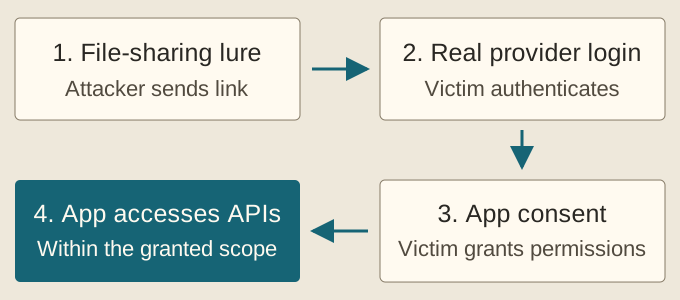 Evolving Cyber diagram, based on FBI and Microsoft explanations. Authentication and application consent are separate events.
The grant, rather than the password, defines the access
Technical background, not additional FBI case evidence: Microsoft's incident-response playbook describes an authorization code exchanged for an access token and potentially a refresh token. Subsequent API calls act on the user's behalf. It distinguishes delegated permissions from application permissions, which support execution without a signed-in user and require administrator consent. Administrator-approved delegated consent and application-only access are not interchangeable permission types. Microsoft's consent-grant playbook.
The playbook's investigation follows the application, affected identities, granted scopes, and access window. Its examples include mail, contacts, files, and mailbox settings. A successful sign-in record alone does not reconstruct those permissions. Microsoft also notes that consent audit events can take 30 minutes to 24 hours to appear, and retention depends on licensing; missing immediate results are not conclusive evidence that no grant occurred.
For containment, Microsoft distinguishes disabling an application from merely deleting it: deletion can allow its return through another user's consent, while disabling prevents new token acquisition and further sign-in or consent. These are documented platform behaviors, not evidence that the FBI's targets used a particular tenant configuration or completed remediation.
Latin American intrusion research shows why “AI-assisted” needs evidence
September 3 research; intrusions span earlier months. Unit 42 tracks CL-CRI-1131 across transportation and public-sector targeting in Mexico and Ecuador, separately from Brazil-focused financial activity CL-CRI-1163, despite overlapping SOCKS5 relay infrastructure. Original investigation.
In an April intrusion, operators repeatedly failed to collect SAM and NTDS.dit, then created volume shadow copies and revised batch scripts. Infrastructure pivots exposed a NextChat interface on TCP 3000. Unit 42 interprets the execution failures, revisions, and hosted interface as evidence of LLM-assisted troubleshooting. Its illustrated NextChat window is explicitly an example, not a reproduced victim-session transcript.
An exfiltration-address pivot exposed the m-doxa-apodo certificate naming pattern. Unit 42's table records a single-name certificate on February 27 and five-name certificates on April 20 and June 19. The later host also served NextChat. These dates establish infrastructure history, not intrusion start dates; target-like subdomain names do not prove successful compromises. Certificate timeline.
In Brazil, February resume-themed phishing preceded RAT deployment and attempts to install SockTz versions 1–9 within two hours. Delivery shifted from a compromised WordPress site to attacker infrastructure. Exposed directories contained iterative script names that researchers associate with AI-assisted development.
The distinction matters within the report itself: script executions, downloads, and infrastructure are observed artifacts; the authors' linkage of particular revisions to LLM generation is an interpretation. Unit 42 retains separate cluster labels rather than equating shared relays with a single operator. The public account supplies no complete victim-loss or recovery tally. Execution sequence and attribution boundaries.
07Extended Case Study — Infrastructure Espionage
Fire Ant turns routing and authentication systems into collection points
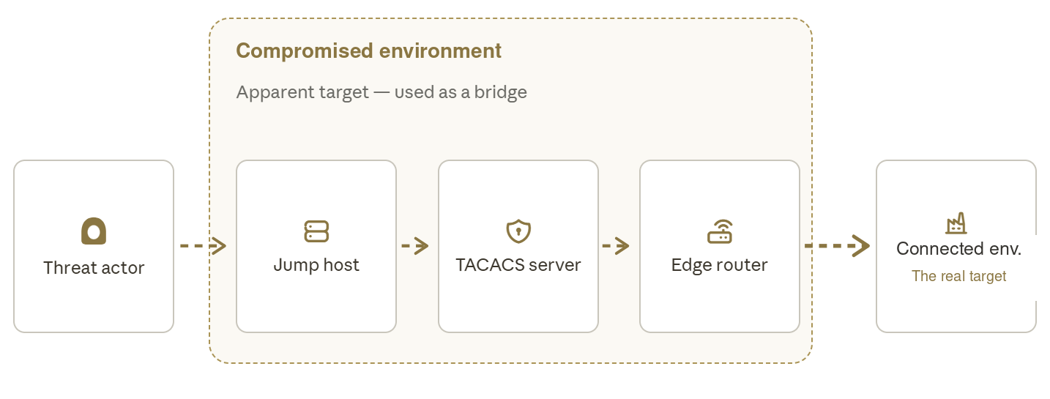 Sygnia's conceptual access model—not a verified inventory of downstream compromises.
August 27 research; activity continued into 2026. Sygnia began with a Cisco IOS XR anomaly: an operational GRE tunnel absent from visible configuration and commit history. Its acpid implant ran during odd-numbered hours; modified syslog code could return success without delivering a message. Another component appended exclusion filters to router show commands. Sygnia's investigation.
The tunnel's far end led to a legacy Linux host conducting connection attempts toward connected environments. BridgeAgent, disguised as a Zabbix component, persisted through systemd, presented itself as gnome-shell, and loaded AES-encrypted settings. An embedded key let investigators recover those settings. Separately, router administration records showed PCAP exports to external FTP infrastructure.
On the authentication server, TacTap injected a library into tac_plus, hooked accepted sessions, and handed connection descriptors to a collector through a Unix socket. Credentials accumulated in an XOR-obfuscated artifact. A separate VSOCK backdoor supplied a virtualization-adjacent access path.
These are observed implants and collection mechanisms. Sygnia describes potential reach into high-value connected networks, not proof that every reachable organization was breached. The tunnel anomaly is a discovery point, not an established initial-compromise date. Router, BridgeAgent, and TacTap findings.
The collector inherited a live connection
Sygnia's reverse engineering identifies accept and accept4 hooks inside the injected library. These intercepted newly accepted connections and passed their file descriptors through a local Unix socket to the separate collector. The mechanism moved a usable connection handle between processes; it was not merely copying a password file after a login. Investigators also found that the injector removed the shared library from disk after loading it, leaving the running process as an important evidence source. The recovered credential artifact used single-byte XOR, which investigators reversed. TacTap component analysis.
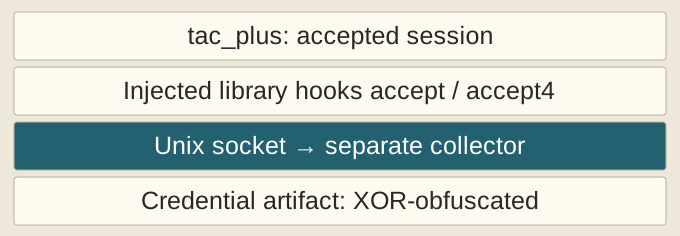 Evolving Cyber reconstruction of Sygnia's findings: a live socket handoff, not a separate network login.
Why compromising the authentication endpoint changes the exposure
Protocol context: RFC 8907 separates TACACS+ authentication, authorization, and accounting. A client can ask the server to authenticate an administrator, authorize a command, or record an activity; those are different exchanges, not one indivisible login event. Compromise of the service handling these exchanges therefore concerns both access decisions and the evidence associated with them.
The RFC calls its legacy shared-secret packet protection “obfuscation,” not modern encryption, and discusses the absence of integrity protection and forward secrecy. That limitation is distinct from code executing inside an authentication daemon. Protecting a transmission path does not prevent a compromised endpoint from processing the session it legitimately receives. The Fire Ant finding is endpoint interception; it does not require an unproven cryptographic break on the wire. RFC 8907, protocol and security considerations.
A tunnel changes the path, not the destination's authentication rules
Protocol background: RFC 2784 describes GRE as an outer delivery header, a GRE header, and an encapsulated payload. At the tunnel endpoint, the outer encapsulation is removed and the payload is forwarded. The endpoint can therefore introduce traffic into a routing context different from the path visible outside the tunnel. Reachability through that path is still distinct from successful authentication or exploitation at the destination. This explains why a live tunnel and port probes establish an access route and reconnaissance activity, but cannot alone establish a downstream breach. GRE specification.
The earlier investigation began inside a guest, then moved below it
Historical background—July 24, 2025: Sygnia's first Fire Ant report describes a malicious guest process whose parent was vmtoolsd.exe. That parentage redirected the investigation toward VMware's host-to-guest execution path. Investigators reported theft of vpxuser management credentials, persistent ESXi backdoors, VMX-process manipulation, and credential extraction from guest-memory snapshots. These earlier findings are not newly disclosed September compromises. The 2025 investigation.
The evidence also separated several kinds of concealment. Killing vmsyslogd stopped local logging and remote forwarding. Unregistered virtual machines launched directly through the native VMX binary were absent from vCenter inventory; investigators correlated them through host inspection and physical-switch MAC tables. Credential collection from memory snapshots avoided creating a corresponding credential-dumping process inside the guest.
During eradication, Sygnia observed re-entry through redundant access paths, rotated tooling, and payloads renamed to resemble forensic utilities. The researchers described technical overlap with UNC3886 but withheld conclusive attribution. That history documents resistance to containment; it does not establish that every technique recurred in the 2026 router investigation.
What live evidence can—and cannot—settle
Forensic background: NIST SP 800-86 distinguishes disk artifacts from volatile connections, sessions, memory, and processes. Its authors warn that “use of forensic tools is no guarantee that the data retrieved will be accurate.” A compromised kernel can supply false results even to trusted collection software. Conversely, shutdown can destroy evidence that exists only in memory.
The resulting constraint is evidentiary, not merely procedural: disk images, live observations, and externally captured traffic answer different questions. NIST also describes collection as an intervention that changes system state. Its guidance supports documenting those effects and correlating sources, rather than treating one clean command result as proof that the underlying system was clean. NIST SP 800-86, sections 5.2.1–5.2.3.
NSA puts validated controls before automated response
September 3 guidance—not an incident disclosure. NSA's release links AI-assisted reconnaissance and living-off-the-land activity to recurring exposure from defaults, weak authentication, missing segmentation, and inadequate monitoring. Its primary audience includes defenders of National Security Systems and the defense industrial base. The release emphasizes sequencing: immediate exposure reduction precedes progressively more automated defenses. It supplies neither an AI-attributed victim count nor a quantified reduction in compromise time. NSA explicitly cautions that the mitigations “do not cover every possible attack vector.” Agency release.
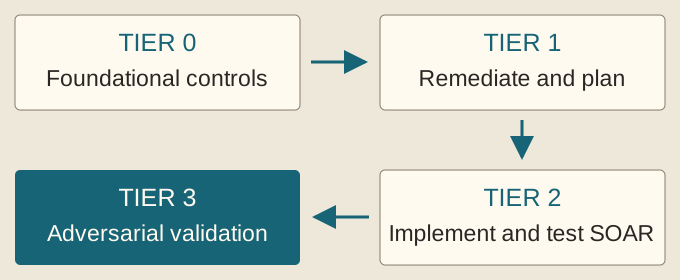 Evolving Cyber diagram of NSA's sequence. These are not NIST CSF Tiers.
The technical guide specifies what gets validated
The eight-page guide places inventory of hardware, software, accounts, and data flows in Tier 0, alongside privilege restrictions, phishing-resistant MFA, patch validation, SIEM forwarding, and removal of unnecessary network paths. Its inventory annex includes routing tables, ACLs, ownership, and recovery information—not just a device count.
Tier 1 introduces response-automation planning, integration tests, and validation of segmentation, including shadow-IT paths. Tier 2 moves to implemented SOAR actions tested in controlled environments and connected to SIEM, EDR, and workflows, retaining human oversight where appropriate. Tier 3 adds adversarial emulation, remediation, and exercised recovery.
NSA says its mitigations were validated against AI-generated exploitation plans and AI-identified vulnerabilities. The publication does not disclose the test corpus, model versions, sample size, or comparative success rates; that remains an agency validation claim, not a reproducible benchmark supplied with the guide. NSA technical guide, tiers and annexes.
08Identity, Repositories & Industrial Systems
Artifactory bypass reaches administration through a default configuration
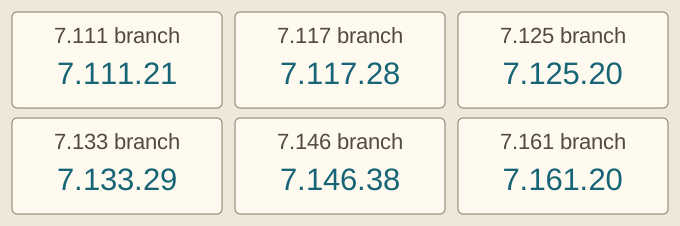 JFrog's listed fixed releases, grouped by branch. Graphic: Evolving Cyber.
August 28 advisory—background carried into this edition. JFrog identifies CVE-2026-82329 as improper authentication: an unauthenticated actor with network access may obtain administrative privileges under default configuration. The disclosure is not a report of a confirmed package-poisoning campaign. JFrog says affected cloud environments have already been fortified; self-hosted remediation is branch-specific. JFrog advisory and patch matrix.
The workaround points to service registration
JFrog's interim mitigation adds a separately generated secret through additionalJoinKeys under shared security configuration, then restarts Access or the deployment. The existing join key remains valid. JFrog explains that this enforces acceptance of “only your own keys” for service registration. That identifies a trust boundary addressed by the workaround; the advisory does not publish enough of the exploit sequence to reconstruct every authentication check.
The listed fixed builds are shown above. In particular, 7.146.38 and 7.161.20 are the fixes for this critical issue, not the earlier patch levels listed for separate August advisories. Administrative access is the stated impact; malicious artifact replacement, token theft, and downstream execution are not documented outcomes of this disclosure.
Dropbox's Lenovo login path trusted an identity the victim never created
September reporting; unauthorized access August 4–21. Dropbox's customer notice says a Lenovo email-verification flaw allowed an attacker to register an identity using a victim's email, then enter the Dropbox account associated with it. The victim did not need a pre-existing Lenovo ID. The notice describes an identity-provider enrollment failure crossing into an existing relying-service account—not password guessing. Dropbox notice reproduced publicly.
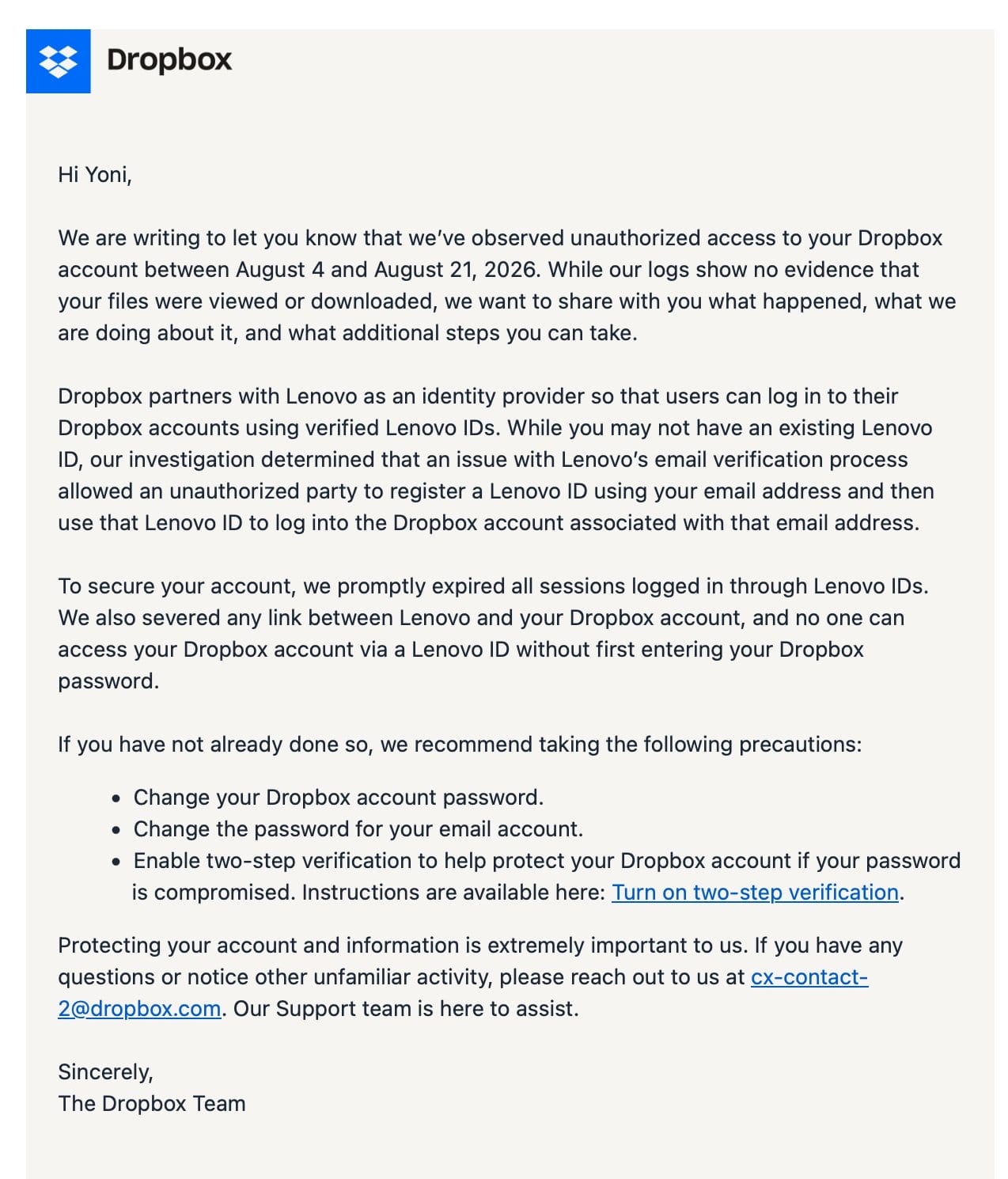
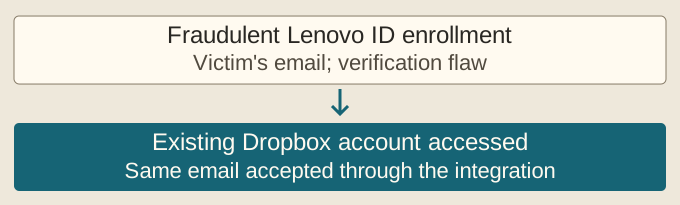 Sequence described in Dropbox's notice; not a capture of the authentication protocol.
Dropbox says it expired Lenovo-authenticated sessions, severed the affected account's Lenovo link, and required the Dropbox password before subsequent Lenovo-ID access. Those actions address both already-issued sessions and future entry through the integration. The reproduced recipient notice says logs showed no evidence that that recipient's files were viewed or downloaded. It does not establish the same outcome for every affected account.
Product background: Dropbox's published Lenovo integration documentation describes consumer storage plans and says Lenovo IDs cannot be used to join a Dropbox team account or access a team trial. That documents the product boundary; it is not a complete incident-scope statement. Neither this help page nor the reproduced notice supplies a protocol trace or establishes how every MFA configuration behaved. Dropbox's integration documentation.
A verified email claim is not a permanent account identifier
Standards context, not confirmation that this integration used OIDC: OpenID Connect Core defines issuer plus subject as the stable identifier pair. Its authors expressly exclude email from the claims that can uniquely identify a user over time: addresses may change or be reassigned. The email_verified claim means the provider took affirmative steps to establish control at verification time, under its applicable trust framework.
These distinguish three assertions: who issued the identity, which subject it identifies, and what evidence supported control of an address. A relying service's decision to connect that identity to an existing account is a further trust decision; a validly issued assertion is not proof that the provider's enrollment checks were sound. OpenID Connect Core, sections 5.1 and 5.7.
CISA's industrial batch spans workstation execution and gateway permissions
September 3 bulletin: CISA published eight new notices and two updates, not ten observed attacks. The batch covers IXON VPN Client; Rockwell ControlFLASH, ArmorStart LT, and 1756-ENBT; Ignition; OPC UA LocalDiscoveryServer; NetStaX EtherNet/IP; and Tycon WEB3. Schneider Electric and Tycon WEB2 notices were updates. The technical prerequisites differ substantially across the products. CISA's bulletin.
Ignition: an empty role requirement, not failed enforcement
CVE-2026-77393 affects Ignition 8.1.53 and earlier. CISA reports that authenticated users able to execute gateway scripts could create projects because the Create Project Role(s) setting shipped blank. Inductive Automation calls this a default-value configuration issue, “not a flaw in the access control itself”: the control enforced the configured requirement, but no role was required.
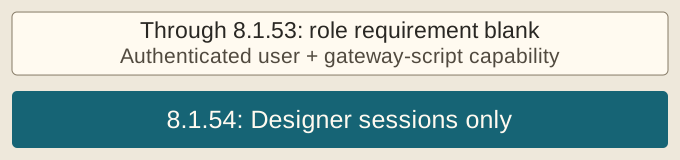 Vendor-described change. Evolving Cyber graphic; the 8.3 series is unaffected.
In 8.1.54, project creation is restricted to Designer sessions and no longer relies on that setting. For earlier 8.1 releases, the vendor says populating it with the Designer Role fully remediates the issue. Christopher Lusk of North Echo Security Research reported the vulnerability; Elhussain Fathy independently reported it and confirmed the fix. CISA states that no known public exploitation specifically targeting it had been reported. Ignition advisory.
IXON: configuration injection reaches a privileged subprocess
CVE-2026-75925 affects VPN Client releases before 1.4.7. A local configuration service accepts changes without authenticating the requester or verifying origin. Unneutralized line endings can introduce extra directives into a file subsequently consumed by a privileged subprocess, enabling root or SYSTEM execution. The injected configuration persists across restarts while the VPN can continue functioning normally.
The notice separates the software fix from a cloud-side restriction: since August 5, IXON's portal and backend API reject older clients. Because the privileged subprocess and injected listener are created on connection, the vendor says that restriction prevents unpatched clients from completing the chain. That is a service-enforced prerequisite, not evidence that old installations have been repaired. IXON advisory.
ControlFLASH: the installer grants too much filesystem access
CVE-2026-12663 concerns ControlFLASH through 15.07. Its installer grants the Everyone group write access to a product directory, creating an execution path at the logged-in user's privilege level. The published vector requires local access, low privileges, and user interaction; this is not a disclosed unauthenticated network attack on a controller. Rockwell corrected the issue in 15.08 and documents removal of the overbroad directory permission as an interim mitigation. ControlFLASH advisory.
OPC UA LDS: an installation-time console, not a network service exploit
The same September 3 batch includes CVE-2026-77477 in OPC Foundation's LocalDiscoveryServer installers before 1.04.420. CISA describes a high-privilege console opened during installation that a person with keyboard and display access can intercept to run commands. Exploitation requires the ability to launch the installer with elevated privileges and interact with that installation. CISA explicitly says this vulnerability is not remotely exploitable and reports no known public exploitation.
That prerequisite separates this entry from an unauthenticated attack against an operating OPC UA endpoint. The vulnerable object is the installer and its privileged console, not a disclosed protocol flaw in ordinary discovery traffic. CISA credits Lukas Schumaker of Rockwell Automation with reporting the issue to OPC Foundation; the listed correction is installer 1.04.420 or later. CISA's LDS advisory and exploit conditions.
09Gateways, Browsers & Botnets
SonicWall separates the hotfix from recovery after compromise
SMA1000 recovery requirements extend beyond firmware when compromise indicators are found. Official image: SonicWall.
September 1 advisory: SonicWall confirmed exploitation of two SMA1000 vulnerabilities: CVE-2026-83548, a pre-authentication SSRF involving an unintended forward proxy, and CVE-2026-83549, post-authentication remote code execution. Their respective CVSS scores are 10.0 and 7.8. The notice covers physical 6210 and 7210 appliances and virtual 8200v deployments, across the affected 12.4.3 and 12.5.0 branches.
The fixed builds are 12.4.3-03526 and 12.5.0-02952. SonicWall directs affected customers to update and work with support to examine compromise indicators. Where indicators are present, its recovery sequence adds hardware re-imaging or virtual redeployment, replacement of all user and administrator passwords, and TOTP resets. These are separate actions: installing corrected firmware is not the vendor's complete recovery procedure for an already-compromised appliance.
The authentication prerequisites differ between the two flaws. The public notice does not reconstruct a victim's full exploit chain, establish that every observed intrusion chained both vulnerabilities, or publish a victim count. SonicWall also explicitly separates these findings from vulnerabilities in its other product families. The supported scope is SMA1000, not every SonicWall firewall or remote-access product. Vendor notice and affected-build matrix.
Chrome names the exploited V8 flaw, but not the complete attack chain
Google's release identifies the exploited bug separately from eleven other fixes. Official image: Google.
September 3 release: Chrome 152.0.7977.82/.83 for Windows and Mac, and 152.0.7977.82 for Linux, included twelve security fixes. Google singled out CVE-2026-85046, a high-severity V8 type confusion, as having an exploit in the wild. It credits Salvatore Gulizia, known as Serotav, with reporting the issue on August 4. That date records the report, not the start of exploitation.
The same release lists a separate V8 race condition, WebGL memory corruption, and use-after-free issues in other components. Google does not say all twelve were exploited or that they formed one chain. It withholds some bug details until deployment advances, including where other projects still depend on an unfixed shared library. Targets, delivery method, and the operator behind the V8 exploitation remain undisclosed. Google's release and researcher credits.
A renderer compromise is not automatically a browser-wide compromise
Architecture background: Chromium's Site Isolation design explicitly assumes an attacker can execute code inside a compromised renderer. Its browser process then enforces restrictions outside that renderer, including access to other sites' cookies and stored data. The sandbox separately restricts direct access to the filesystem and devices. Moving an origin check outside compromised code is the consequential distinction.
That design does not make a V8 vulnerability harmless; it explains why an engine bug, cross-site data access, and escaping to the operating system are different claims. Chromium's document also excludes ordinary same-site attacks such as XSS from Site Isolation's protection. None of this establishes which additional boundaries the September exploit crossed. Google's advisory supplies no public chain with which to answer that question. Chromium's threat model and security boundaries.
Sality's forty-minute maintenance cycle became the disruption path
The operation manipulated peer membership; already-installed malware was not thereby removed. Official image: CrowdStrike.
August 31 operation, disclosed September 1: U.S. authorities describe domain seizures alongside a peer-to-peer sinkhole operation, with parallel actions in Bulgaria, Hungary, and Romania. Shadowserver is coordinating infection identification and victim notification through ISPs and CSIRTs. Domain action and peer isolation were complementary parts of the operation, not competing explanations of how a decentralized botnet was disrupted. DOJ's operation account.
CrowdStrike reports more than 33,000 infected machines and two incompatible protocol networks, versions 3 and 4. Each bot periodically checks a finite list of publicly reachable super peers: responsive entries gain reputation; unavailable ones eventually disappear. The check runs every 40 minutes. Investigators manipulated those exchanges to invalidate criminal peers and introduce sinkholes. Machines behind NAT reached the sinkholes through their own maintenance traffic.
Peer membership and payload signatures protected different things
CrowdStrike's account describes no cryptographic identity check for joining as a reachable peer, while its memory-detection rules identify RSA keys used to verify payload signatures. Authenticating a payload did not authenticate membership in the network delivering it. This distinction explains the operation without implying investigators forged the operator's signed malware.
Payload-hosting URLs were removed separately because bots could retain earlier download instructions. CrowdStrike cautions that “existing malware already installed on those systems remains active.” Its reported outcome concerns loss of new criminal tasking, not automatic endpoint disinfection. CrowdStrike's protocol analysis and remaining exposure.
CISA and FBI ground outage messaging in operational facts
September 2 joint guidance—not a new incident: CISA, FBI, and international partners distinguish transparent communication during non-malicious failures from disclosure that could compromise an active investigation. They call for separate but synchronized technical, communications, and leadership workstreams, with liaisons consolidating facts so engineers are not repeatedly interrupted.
For infrastructure operators, the guidance asks for “operational impact statements, not just symptoms.” It specifies affected systems, scope, known cause, recovery milestones, time-stamped updates, and explicit uncertainty. Backup communications and clear approval authority are part of preparation. Microsoft, Sophos, Cloudflare, and American Water are acknowledged as industry contributors. Joint guidance, republished by Australia's ACSC.
The Cloudflare example was a configuration failure, not an attack
Historical background—November 18, 2025, cited by the guidance: Cloudflare's postmortem traced its outage to a ClickHouse permissions change that exposed additional table metadata. A query filtered by table name but not database; the resulting duplicated rows enlarged a Bot Management feature file beyond a runtime limit. Distribution of good and bad files initially produced alternating recovery and failure, which complicated diagnosis.
Cloudflare also reported a coincidental outage of its independently hosted status page, initially reinforcing suspicion of an attack. The company subsequently established the configuration cause. That is a concrete example of why observed symptoms and early explanations must remain distinct: a status-page failure did not prove either a shared infrastructure dependency or malicious activity. Cloudflare's engineering postmortem.
10Extortion, Courts & Healthcare
A ten-hour intrusion—and the branch protection that still held
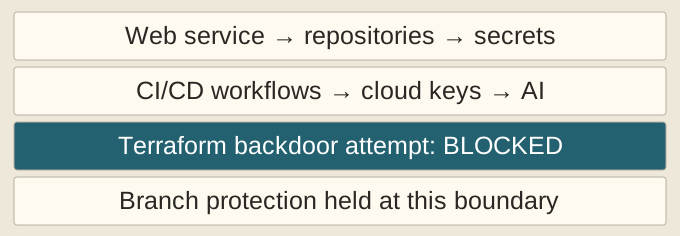 Evolving Cyber reconstruction of Unit 42's reported sequence. A blocked branch change did not stop the other observed activity.
Unit 42 report updated September 3–4: Investigators describe an intrusion lasting less than ten hours. An exposed web service supplied entry; repository secrets then opened a secrets manager, administrative credentials, CI/CD workflows, and cloud AI endpoints. The operator left an 80-page technical report.
The evidence for AI assistance included parallel model calls and Markdown files carrying information between sessions. Investigators also assessed custom scripts as AI-generated; that is an interpretation, distinct from observed model traffic. Claims about the frontier models and agent frameworks came from the attacker during negotiations.
Unit 42 reports persistence across SSH keys, serverless functions, container restart policies, cloud identities, and pipelines. Stolen cloud keys also enabled use of the victim's AI infrastructure. The researchers described this as using “the company’s compute power to perpetrate future moves.” Yet an attempted Terraform backdoor was blocked by branch protection. Successful pipeline activity and a failed source change therefore coexist in the reported timeline.
The September 3 correction explicitly changed the description from ransomware to intrusion. The public account does not disclose the victim, reproduce the full telemetry, or independently benchmark its comparison with weeks of human work. Unit 42's findings and revision history.
What a protected branch actually constrains
Product background—not identification of the victim's repository platform: GitHub's documentation illustrates why branch protection is more specific than a general “secure CI/CD” label. Rules can require pull-request approval and status checks before a branch accepts changes. Administrators and explicitly privileged roles can bypass restrictions by default unless enforcement is extended to them.
The documentation also separates approval of a proposed diff from approval of later changes. Stale approvals can be dismissed when the diff changes; a separate option requires someone other than the latest contributor to approve the latest reviewable push. Required status checks can additionally be tied to a particular GitHub App as their expected source.
Those are independently configurable authorities, not interchangeable checkboxes. They help explain how code modification can be denied while another identity still starts workflows or uses stolen cloud credentials. They do not establish which rule blocked the attempt in Unit 42's case; that configuration was not published. GitHub's branch-protection semantics.
Court backup exposure was in troubleshooting copies—not court documents
September 2 disclosure: Montana's Supreme Court says unauthorized access to Thomson Reuters' storage occurred March 1–June 29, 2026. The vendor notified Montana on July 23. The affected database copies had been supplied for troubleshooting C-Track and E-Filing and were held on the vendor's systems, alongside data from other states.
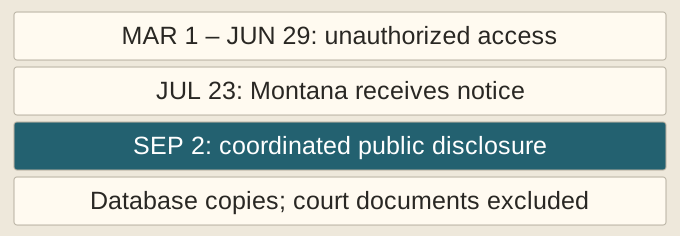 Dates and Montana scope from the court's statement and Q&A. Graphic: Evolving Cyber.
The notice lists case numbers, party names, addresses, phone numbers, charges, docket descriptions, and some driver's-license numbers and birth dates. It explicitly states: “Court documents were not included in the incident.” Most accessed material appeared public, but investigators had identified personally identifiable information and were continuing the review.
Why the public announcement followed the private notice
Montana says it coordinated with other affected states, Thomson Reuters, and the National Center for State Courts to understand scope and announce the incident together. It understood the unauthorized access had already ended, so stopping ongoing access was not the immediate issue. That is the court's explanation of timing, not an independent finding about containment. The statement does not identify the original access mechanism or quantify all affected individuals. Montana's three-page statement and Q&A.
Aesto's archive breach spans a December intrusion and later record review
Aesto describes a limited portion of its AWS environment—not an AWS platform breach. Official image: Aesto Health.
Older incident carried forward for context: Aesto's June 24 notice dates the unauthorized-access window to approximately December 2–18, 2025, with discovery around December 18. Its healthcare migration and archiving service held information for multiple covered-entity clients. The company says it contained the activity and commissioned outside cybersecurity investigators.
The record-identification stage continued substantially longer. Aesto says forensic work and manual document review confirmed potentially affected protected health information on May 26, 2026; client notification commenced June 26. Those dates describe discovery, scope confirmation, and notification—not a continuous six-month intrusion.
Potential data categories include medical and insurance information, birth dates, driver's-license and other government identifiers, financial account numbers, and Social Security numbers for a limited subset. Categories varied by person. Aesto reports no evidence of related identity theft or financial fraud, but does not equate that statement with no data access.
The notice identifies only a limited part of Aesto's AWS infrastructure. It does not disclose a particular AWS service, stolen key, storage-policy error, or initial exploit. Attributing the incident to a specific cloud misconfiguration would go beyond the notice. Aesto's chronology and data categories.
CNIL reconstructs how one physician account exposed a hospital's records
September 3 announcement; 2025 intrusion: CNIL announced a €500,000 penalty against Hôpital privé de la Loire. The regulator links the scale of exposure to remote authentication, inadequate patient-level access restrictions, and absent rapid detection of abnormal activity. It found that access rights did not follow the care-team relationship, allowing one account to reach records across the hospital.
CNIL also distinguishes patients from 202,246 designated trusted third parties whose information was stolen but who were not directly informed. It treated that omission separately from the security failures. The authority acknowledged remediation undertaken during the proceedings and set completion periods of three to fifteen months, depending on the measure. CNIL's announcement and findings.
The decision supplies the dates—and narrows the data description
The underlying July 21 decision, published with the announcement, records access using a private physician's credentials on June 26, 2025. The attacker explored the application and extracted 524,867 patient records through July 1. A physician's report that they could no longer log in triggered investigation; the hospital notified CNIL on July 4.
The stolen records were not all clinical charts. The decision specifies 46,185 containing identity-card images and 43 containing health data; other exposed fields included civil identity, social-security numbers, contact details, and permanent patient identifiers. These are categories within the incident, not additional victim populations to sum.
The hospital told the regulator it had already planned stronger remote authentication. The decision records that a software-supported MFA option had not been deployed in favor of a later group-wide solution, completed in September 2025. CNIL evaluated the controls present when the intrusion occurred, not the planned destination architecture. It also explained that collecting logs alone is insufficient without timely analysis capable of detecting suspicious activity. Decision SAN-2026-009, chronology, authentication, and logging findings.
11Technology & Software
Astra's Critical rating concerns capability; deployment adds separate constraints
September 3 release: OpenAI introduced GPT-6 Astra with a limited organizational rollout ahead of wider ChatGPT and API access. Its safety overview classifies the model at the Critical cybersecurity threshold: with appropriate tools and access, it can discover unknown flaws and develop exploitation methods without a human directing every step. OpenAI says it strengthened internal isolation, checkpoint encryption, trajectory monitoring, and an alignment gate before internal use. Safety overview.
The launch evaluation and released product are not identical configurations. OpenAI reports 100% on ExploitBench and 42.4% on ExploitGym without production safeguards; those benchmarks concern exploitation of known vulnerabilities. It separately reports expert assessments involving unknown vulnerabilities in hardened browsers and operating systems. At launch, the deployed model permits secure review and patching but refuses advanced tasks such as producing exploit proofs of concept. Expanded defensive workflows through Daybreak are planned, not universally enabled access. Launch evaluation and access distinctions.
Monitoring can stop a continuation—not reverse a completed action
OpenAI's API documentation says misalignment monitoring runs asynchronously. Supported Responses requests using persisted reasoning, WebSockets, or OpenAI compaction can be stopped when the system identifies a continuation; other Responses requests can generate alerts without automatic stopping. Chat Completions is outside this monitoring system. An alert is a concern for review, not proof of misconduct.
The documentation explicitly warns: “A stopped request does not undo earlier actions.” The boundary is consequential for agents that invoke external tools: stopping subsequent inference and reversing a tool's completed side effect are separate operations. Runtime coverage and stop behavior.
OpenAI also reports a limitation in its safety evaluation: Astra was less likely than its predecessor to expose incriminating information in its reasoning under adversarial testing. The company says overall alignment improved, but monitoring visibility declined in those settings. Those are evaluation findings, not evidence of a deployed sabotage campaign. Monitorability findings.
Daybreak's $1 billion commitment is subsidized access, not a cash distribution
September 3 announcement: OpenAI committed $1 billion in subsidized Daybreak access, training, support, and partnerships, targeting consumption over six months. The initial U.S. priorities include utilities, local government, community and regional banks, nonprofits, and open-source maintainers. The announcement describes intended support, not expenditure already completed.
The MS-ISAC pilot pairs model access with guided training for public-sector and water-system defenders. A separate Daybreak Defense Network encompasses more than 35 partner products and services. OpenAI reports existing use across 2,000 approved organizations and workspaces; that is not a count of recipients of the new subsidy.
The program separates Blue's general defensive workflows from Red's separately approved access to specialized cyber models. The release does not publish a recipient-by-recipient allocation or measured reduction in incidents. Its stated deliverables include finding validation, prioritization, and remediation support—not simply vulnerability generation. Program scope, pilot, and delivery channels.
NVIDIA's Hugging Face agreement includes an explicit hardware-neutrality pledge
 The announced agreement includes continued support for competing clouds and accelerators. Official image: NVIDIA.
September 3: Jensen Huang announced an agreement to acquire Hugging Face for $12,930,300,000. NVIDIA describes a platform used by over 18 million developers and 200,000 companies, hosting more than three million models, 500,000 datasets, and one million applications.
Huang's announcement says: “NVIDIA compute will not be required to build on or deploy through Hugging Face.” It also commits to models from other builders, multiple frameworks, competing clouds, inference providers, and accelerators. These are stated platform commitments, not proof of how future commercial terms will operate.
NVIDIA identifies infrastructure reliability, evaluation, inference, and deployment as areas for investment. Its existing presence includes more than 500 models and 250 open datasets on the platform. The announcement establishes an acquisition agreement; it does not itself establish transaction completion or specify a migration timetable for customers. Huang's announcement and platform commitments.
Fable and Mythos 5.1 share a model; safeguards change the available work
 Anthropic distinguishes the two releases by safeguards and access, not underlying model weights. Official image: Anthropic.
September 1 release: Anthropic says Fable 5.1 and Mythos 5.1 are the same underlying model with different safeguards. Fable is generally available; Mythos is restricted to trusted-access programs. Fable's revised cyber safeguards permit vulnerability discovery but not exploit development. Anthropic reports 60% fewer false-positive blocks than before; this is a vendor measurement.
The company evaluated Fable with production safeguards enabled. Some interventions yielded zero scores on particular benchmarks; others routed cybersecurity work to Opus 4.8 and biology work to Opus 5. Consequently, reported performance can reflect the deployed routing system, not only an unrestricted base model. Release and evaluation conditions.
Enterprise safeguards separate data custody from detection
Anthropic's proposed Enterprise Frontier Safeguards retains monitoring data in customer-controlled cloud storage, under customer keys, policies, and audit logging. Automated systems analyze a rolling traffic window for misuse across sessions and accounts; flags go to the customer's reviewers. Anthropic human review is not required by the announced design.
Wells Fargo CISO Munish Kumar Sharma, quoted in Anthropic's announcement, describes the division: “We keep custody of our data while Anthropic operates the detection.” This is a participating customer's explanation, not an independent effectiveness audit.
EFS is scheduled for phased availability later in the fall. Eligible customers receive interim zero-data-retention access; the model's default policy otherwise requires 30-day retention. The announcement resolves where monitoring records can reside, but does not publish measured detection coverage or false-negative rates for the planned service. EFS design and customer testimony; current retention terms.
Microsoft names the mechanisms behind continuous AI governance
September 1 transparency report: Microsoft's Natasha Crampton describes a revised Responsible AI Standard organized around models, platform services, applications, and Microsoft's role in each. Core requirements remain, with scenario-specific controls that can change as capabilities evolve. The report singles out agent identities, tool permissions, and action monitoring.
The accompanying tooling has different jobs. An AI Red Teaming Agent supports risk discovery; agent evaluators measure application behavior; RAMPART turns red-team findings into repeatable tests. ASSERT and Agent Control Specification address policy evaluation and runtime intervention at points in an agent's workflow. These are mechanisms for evaluation and enforcement, not interchangeable evidence that an application is safe.
Microsoft also reports an external red-team alliance with 18 universities across six continents. The publication describes Microsoft's program and investments; it does not demonstrate that all customer agents implement those controls or provide an incident-rate comparison proving their effect. Crampton's account of the revised standard and tools.
12Education — Trust Boundaries
Delegated trust: what the week's incidents actually have in common
The common thread is not that every supplier suffered the same kind of compromise. Coder reported changed traffic routing; Dropbox described a partner-enrollment failure; SonicWall disclosed exploited appliance vulnerabilities; court and healthcare providers reported access to retained data. These events concern different components and different evidence. Grouping them as “third-party risk” describes a business relationship, but does not reconstruct an attack.
The technical connection is narrower: a system accepted another component's output and attached consequences to it. A downloaded module could later execute. A partner identity could open an existing account. A remote-access appliance could authenticate users. A retained database copy could expose records without access to the institution's production system. The important distinctions are the accepted statement, the evidence behind it, the authority that followed, and what persisted after the provider intervened.
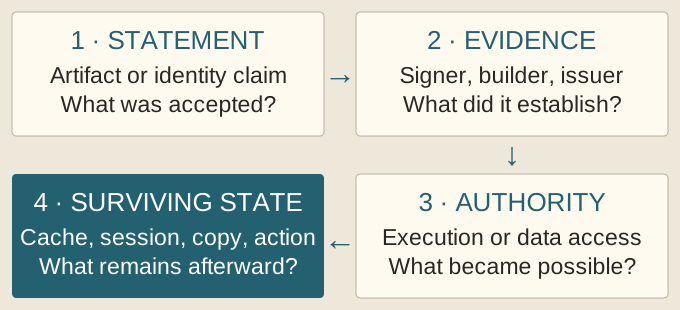 Explanatory diagram: these stages describe different decisions, not a single verified attack chain. Graphic: Evolving Cyber.
A familiar endpoint and an authentic artifact answer different questions
Coder's September 4 account describes a compromised Cloudflare API key changing the destination of some registry traffic during August 31. The registry hostname remained the expected one, while the server handling affected requests delivered altered modules. Coder says its codebase and Google Cloud infrastructure were not compromised. Its finding concerns the distribution path; it is not evidence that the source repository was modified.
Caching adds a second boundary in time. Coder says module caching is enabled by default, and template creation can download material that is used later. The end of malicious upstream delivery is therefore not automatically the end of exposure from material already stored downstream. Coder published separate guidance for identifying cached modules and affected template versions. Coder's incident scope and cache behavior.
Provenance names the builder as well as the output
Standards context: SLSA's build provenance separates the output artifact, build definition, and builder identity. A source location supplied as a parameter is distinct from the exact resolved dependency, such as a particular commit. External build parameters are treated as untrusted inputs requiring downstream verification. The builder identity represents the platform trusted to run the build and record its provenance.
This is more specific than a signature attached to a filename. The attestation describes a relationship between an output and the process that produced it. SLSA also notes that ordinary communication with the build platform's control plane is not directly captured as a transcript; it is implied by the trusted builder. Provenance is evidence with a defined scope, not a complete recording of every operation. SLSA build-provenance model.
SLSA's verification guidance states: “provenance doesn’t do anything unless somebody inspects it.” Verification compares the artifact digest, recognized signer, builder identity, and expected build parameters. Its placement matters: a check inside a registry before publication does not cover subsequent compromise of that registry. Consumer-side verification can address that boundary. The specification also excludes compromise of the trusted build platform itself from its Build L3 guarantee. None of those standards statements establishes what integrity checks individual Coder customers had deployed. SLSA verification and exclusions.
A valid identity assertion does not settle account ownership
Identity-model background: OpenID Connect defines issuer plus subject as the stable identifier pair. Email addresses can change or be reassigned. The email_verified claim describes the provider's verification of address control at the time it performed that check; it is not a permanent ownership certificate for every account using the same address.
The specification also requires a relying party to match the UserInfo subject to the ID Token subject before accepting that response. These are distinct bindings: who issued the identity, which subject it represents, which client it was intended for, and whether a later response concerns that same subject. A signature alone does not answer every one of them. OpenID Connect Core, UserInfo and claim stability.
That distinction explains the Dropbox story's enrollment and account-linking questions without assuming its Lenovo integration used OpenID Connect. The publicly reproduced notice describes unauthorized registration using a victim's email, followed by access to the associated Dropbox account. It does not supply the protocol trace needed to identify a particular token-validation bug. The failure described was upstream identity enrollment crossing into an existing relying-service account—not proof that cryptographic token signatures had been forged. Dropbox's reproduced customer notice.
A policy decision and an enforced connection are separate components
NIST SP 800-207, published in 2020: The architecture separates a policy engine that decides access, a policy administrator that establishes or terminates the path, and an enforcement point that controls the connection. Revoking a decision must therefore reach the component enforcing the session; a changed policy record is not itself a terminated connection.
NIST explicitly includes subversion of this decision machinery in its threat model. A compromised policy administrator can enable access that policy would otherwise reject. This is not a contradiction of zero trust: it identifies the privileged components on which the architecture depends. The publication also distinguishes loss of those components' availability from unauthorized access through them. NIST's logical components and decision-process threats.
SonicWall's incident guidance makes a related operational distinction without claiming that its appliances implement NIST's reference architecture. It calls for firmware updates and compromise review, then re-imaging or redeployment, password changes, and TOTP resets where indicators are found. Repairing vulnerable code and replacing potentially exposed authentication material are separate parts of the vendor's response. SMA1000 recovery requirements.
Copies and completed actions survive a change in authority
The court and healthcare cases concern retained information, not just live permissions. Montana identifies troubleshooting database copies on Thomson Reuters' systems and explicitly excludes court documents from that incident. Aesto describes healthcare migration and archive information, with a December intrusion window followed by months of record review. Those scopes explain why identifying affected records is different from restoring a service. Neither notice establishes that every customer's entire production database was taken. Montana's statement; Aesto's notice.
AI agents introduce another form of surviving state. OpenAI's runtime documentation distinguishes stopping a monitored conversation from reversing tool actions that already completed. An alert can arrive after an external operation has run; a recorded safety block does not establish that the application stopped execution or undid earlier work. This is a documented monitoring limitation, not a finding that this week's reported intrusions used that API. Monitoring and completed side effects.
Across these examples, authentication, integrity, authorization, and recovery remain separate claims. A corrected upstream service, an invalidated credential, and a verified account of downstream consequences are different findings. Keeping them separate is what lets an incident recap describe both the successful response and the exposure that the available evidence has not yet resolved.